
Flexible Office Market to Reach USD 97.45 Billion by 2032, Driven by Hybrid Work, Cost Optimization and Enterprise Managed Offices, Says Mordor Intelligence
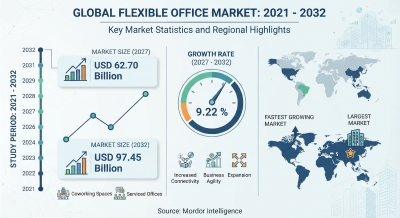
Hyderabad, India, November 27, 2026: According to Mordor Intelligence, the Flexible Office Market Size is projected to increase from USD 57.41 billion in 2026 to USD 62.70 billion in 2027 and reach USD 97.45 billion by 2032, registering a CAGR of 9.22% during 2027-2032. The market is gaining momentum as hybrid working models increase demand for adaptable office capacity, corporate real estate teams optimize costs, startups and SMEs seek ready-to-use offices, multinational companies enter new markets, and enterprises adopt customized managed-office solutions.
The Flexible Office Industry is being shaped by changing workplace attendance patterns, lower tolerance for underutilized office capacity, and demand for workspace that can expand or contract with business requirements. Providers with broad networks, private offices, secure managed spaces, consistent service standards, and multi-location access are well positioned to serve enterprise customers. Long property commitments and fluctuating client demand remain important operational risks.
Flexible Office Market Growth Drivers
Growing Demand for Flexible Office Capacity from Hybrid Work Models
Hybrid work has become a sustained component of workplace planning. Companies need space for meetings, collaboration, project teams, and periodic office attendance without necessarily expanding their permanent office footprint. Flexible offices allow capacity to be adjusted across locations and time periods.
Corporate Real Estate Cost Optimization Driving Flexible Leasing
Companies are increasingly evaluating total occupancy costs and avoiding unnecessary fit-out expenditure. Ready-to-use flexible offices can bundle desks, furniture, connectivity, meeting rooms, and workplace services under one agreement, reducing the time and upfront cost needed to establish a new office.
Startup and SME Expansion Supporting Ready-to-Use Office Demand
Startups and smaller companies often require professional workspace without committing to long leases or large fit-outs. Flexible offices allow these users to establish operations quickly, test new locations, and adjust capacity as teams change.
Multinational Expansion Increasing Demand for Serviced Offices
Companies entering new markets may use serviced offices and managed spaces before establishing permanent facilities. This supports demand for private suites, secure infrastructure, reception services, and local workplace support in major business centers.
Decentralization of Corporate Workplaces and Growth of Managed Offices
As employees live farther from headquarters and companies distribute teams across multiple locations, demand is expanding beyond central business districts. Customized managed offices can provide enterprise clients with consistent service, security, branding, and technology across several locations.
Access This Report in Japanese: https://www.mordorintelligence.com/ja/industry-reports/flexible-office-market?utm_source=abnewswire
Flexible Office Market Segmentation
By Type
-
Co-Working Space
-
Serviced Offices / Executive Suites
-
Others (Hybrid, Virtual Office)
By Sector
-
Information Technology (IT and ITES)
-
BFSI (Banking, Financial Services and Insurance)
-
Business Consulting and Professional Services
-
Other Services (Retail, Life-Sciences, Energy, Legal)
By End Use
-
Freelancers
-
Enterprises
-
Start-Ups and Others
By Geography
-
North America
-
United States
-
Canada
-
Mexico
-
South America
-
Brazil
-
Argentina
-
Chile
-
Rest of South America
-
Europe
-
United Kingdom
-
Germany
-
France
-
Italy
-
Spain
-
Netherlands
-
Russia
-
Rest of Europe
-
Middle East
-
Saudi Arabia
-
United Arab Emirates
-
Turkey
-
Rest of Middle East
-
Africa
-
South Africa
-
Nigeria
-
Rest of Africa
-
Asia-Pacific
-
China
-
India
-
Japan
-
South Korea
-
Australia
-
Indonesia
-
Rest of Asia-Pacific
By Type
Co-working space remains the largest format, reflecting broad demand from enterprises, startups, freelancers, and distributed teams. Serviced Offices and Executive Suites are expected to grow faster as enterprises seek private, turnkey, secure, and professionally managed space.
By Sector
IT and ITES represent the largest sector because technology companies value connected and scalable office environments. BFSI is the fastest-growing sector, with demand supported by the need for private suites, controlled access, reliable technology, and compliance-oriented workplace environments.
By End Use
Enterprises provide the largest demand base, using flexible offices for project teams, distributed employees, temporary expansion, and market entry. Freelancers are expected to grow quickly as independent professionals seek short commitments and flexible access, while startups and smaller users continue to support occupancy in emerging locations.
Flexible Office Market Regional Insights
Asia-Pacific remains the largest regional contributor to the flexible-office market, supported by strong demand across major economies such as India, China, and Southeast Asia. India is emerging as a major flexible-office market, supported by expanding workspace supply and rising demand from enterprises, startups, and independent professionals. South America is expected to record the fastest regional growth, with Brazil serving as a key market. Europe, the Middle East, and North America continue to generate demand from enterprises, freelancers, and users seeking flexible office options beyond traditional business districts. Management agreements are also enabling flexible-office providers to expand their networks while reducing the cost and risk associated with conventional leasing.
Explore Our Full Library of Real Estate and Construction Research Reports: https://www.mordorintelligence.com/market-analysis/real-estate-and-construction?utm_source=abnewswire
Flexible Office Market Key Players
The Flexible Office Market includes IWG plc, WeWork Companies LLC, The Office Group, Mindspace Business Parks REIT Limited, Wojo, Awfis Space Solutions, Talent Garden S.p.A., Huckletree, JustCo, Industrious, Impact Hub GmbH, Techspace, Labs, Deskopolitan, Utopicus, Station F, Ordnungs ApS, Matrikel 1, Fora, and Orega.
The competitive landscape is fragmented, although large operators are expanding through partnerships, acquisitions, and third-party access arrangements. Competition is shaped by network reach, private and shared workspace quality, pricing, technology, security, enterprise service, and landlord relationships. Management agreements and partnerships are increasingly important because they allow operators to expand while reducing direct lease exposure.
Flexible Office Market Forecast
The Flexible Office Market Forecast remains positive through 2032 as hybrid work, corporate cost optimization, startup expansion, multinational market entry, and enterprise managed-office demand support sustained adoption.
Providers are expected to expand through management agreements, partnerships, and third-party access networks. These models can improve geographic coverage while limiting the capital and lease exposure associated with traditional expansion. Private offices, serviced suites, secure technology, and customized managed spaces are expected to gain importance in enterprise contracts.
Operational risk remains significant because providers may maintain long-term property commitments while client demand can fluctuate. Strong location selection, flexible property structures, standardized service delivery, and diversified enterprise relationships will remain important to sustainable growth.
For more insights on this market, please visit the Mordor Intelligence page: https://www.mordorintelligence.com/industry-reports/flexible-office-market?utm_source=abnewswire
About Mordor Intelligence
Mordor Intelligence is a global market intelligence firm, founded in 2014, helping businesses make informed decisions through data-driven insights, industry expertise, and advanced analytics. With 550+ domain experts and on-ground specialists across 180+ countries, the company delivers comprehensive intelligence across aerospace & defense, agriculture, automation, automotive, chemicals & materials, consumer goods & services, electronics, energy & power, financial services, food & beverages, healthcare, hospitality & tourism, information & communications technology, and logistics. Its offerings include syndicated industry reports, custom research and advisory, and subscription platforms such as Synapse, Data Center Intelligence, and Robotics Intelligence. Mordor Intelligence is ISO 9001:2015 and ISO/IEC 27001:2022 certified, a member of ESOMAR and the Market Research Society of India, and a four-time Great Place to Work® honoree. Learn more at mordorintelligence.com.
For any inquiries or to access the full report: media@mordorintelligence.com, https://www.mordorintelligence.com/contact-us
Media Contact
Company Name: Mordor Intelligence
Contact Person: Jignesh Thakkar
Email: Send Email
Phone: +1 617-765-2493
Address:11th Floor, Rajapushpa Summit, Nanakramguda Rd, Financial District, Gachibowli media@mordorintelligence.com
City: Hyderabad
State: Telangana 500008
Country: India
Website: https://www.mordorintelligence.com/


