
Engineering Absolute Safety: How an Advanced Disconnection Device is Stopping Electrical Panel Fires
Guangzhou, China – November 03, 2026 – A ticking time bomb sits inside thousands of electrical distribution boxes across Europe and South Africa. For years, the market has been flooded with low-cost surge protective devices (SPDs) built from generic public molds. When a severe lightning strike or power grid fluctuation occurs, these cheap units often fail catastrophically. The core issue lies in the physical design of the safety mechanisms. In a standard cheap SPD, a massive electrical surge causes the internal solder to melt. However, instead of breaking the circuit cleanly, the molten metal stretches into a thin wire. Current keeps flowing across this gap, creating a continuous electric arc. This arc generates intense heat, melting the cheap plastic housing and eventually setting the entire distribution panel on fire. Industry data indicates that a significant percentage of industrial electrical fires originate from failed low-voltage protective components. The industry does not need another generic SPD; it needs a fundamental redesign of the physical safety barrier.
Zero Panel Fires: Total Liability Protection for Electrical Contractors
For electrical contractors and brand distributors, a panel fire is the worst-case scenario. It destroys client trust, leads to massive financial liabilities, and ruins brand reputations. Installers need absolute certainty that the components they fit into a factory or commercial building will fail safely. By switching to a fundamentally redesigned SPD that physically guarantees arc isolation, distributors and installers can completely eliminate the risk of post-surge fires. This shift protects profit margins by reducing warranty claims and prevents disastrous product recalls. From a professional industry perspective, safety is not just a technical spec; it is the ultimate commercial shield. This level of absolute reliability is backed by rigorous TUV, CB, and CE certifications, proving that the device absorbs the hit and dies quietly without taking the rest of the electrical panel down with it.
The Reinforced 8mm Contact Pin Defense Mechanism
When a Type 2 transient overvoltage event hits, the physical shockwave inside the device is violent. Standard SPDs use thin metal pins, usually around 4 to 7 millimeters wide and 0.5 millimeters thick. Under the extreme kinetic stress of a 20kA or 40kA surge, these thin pins vibrate violently. They often lack the structural integrity to hold the device together, causing the plastic base to crack or shatter entirely. To solve this, the engineering team at LSP developed custom private molds featuring reinforced metal contact pins that are 8 millimeters wide and 0.8 millimeters thick. This makes the metal contacts roughly 45% thicker than standard industry alternatives. The physical advantage is immense. These heavy-duty pins absorb the mechanical shock and maintain a tight, unyielding grip on the base. As a result, the SPD casing remains completely intact even under the most severe 8/20μs impulse tests. Installers gain a rugged device that survives extreme physical stress, ensuring the electrical system remains physically secure. Extensive 48-hour salt spray testing on these fog-tin plated copper components further guarantees they will not rust during long ocean freight transits.
The Guillotine Effect: Green Baffle Arc Isolation
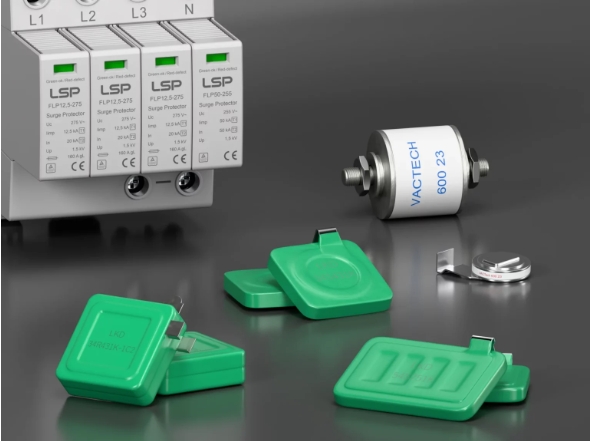
The most critical moment in an SPD’s lifecycle is the exact second it must disconnect from the power grid. As mentioned earlier, cheap SPDs fail because the melting solder creates a dangerous arc. LSP engineered a unique flat disconnection device to solve this specific failure point. Inside the enlarged cavity of their custom mold sits a spring-loaded green plastic baffle. When the thermal threshold is breached, this baffle acts like a guillotine. It pops out instantly, physically slamming down between the melted solder joints. This action violently cuts the molten wire and blocks the two contact points from each other. An isolated arc-extinguishing chamber is formed in a fraction of a second. The barrier is designed to increase the separation between the opened contacts, interrupt a conductive solder path and reduce the likelihood of a sustained arc. End-users and facility managers get a fail-safe device that completely removes the risk of continuous heating and fire hazards. In strict thermal stability testing, which runs continuously for two to three days, this exact mechanism proves its ability to break the circuit safely every single time.
Why Automated Manufacturing Destroys Thermal Stability
Many large-scale factories boast about their fully automated assembly lines. But in the world of surge protection, a uniform soldering profile may be unsuitable when different SPD models require different thermal disconnection characteristics. Standard public molds force factories to use automated high-temperature wave soldering for all components. This intense, uniform heat often damages or alters the sensitive low-temperature trip point—the very mechanism designed to melt and protect the circuit. If this joint is compromised during manufacturing, it may not release as intended when the MOV later experiences abnormal sustained heating or end-of-life degradation. LSP uses automated processes where appropriate while retaining a controlled manual process for the model-specific low-temperature disconnection joint. Instead, highly skilled technicians with over ten years of experience handle the low-temperature soldering manually. They use precise, specialized soldering stations that maintain strict temperature controls (for example, LSP states that it applies model-specific soldering process settings, including approximately 140°C for the SLP40 Type 2 and 190°C for the FLP12.5 Type 1+2 design). They apply high-quality QLG solder directly onto the purple copper contacts. This meticulous, manual approach ensures the thermal disconnect point remains pristine. The resulting device trips exactly when the internal heat reaches the danger zone. The process is intended to provide consistent release behavior under the specified thermal-disconnection test conditions.
Redefining Supply Chain Economics for European OEMs
Top-tier global brands charge a massive premium for their equipment, but the actual performance is dictated by the internal core components. Many local factories use low-grade Metal Oxide Varistors (MOVs) wrapped in cheap AB glue, which easily absorb moisture and fail early. LSP takes a completely different route. They build their SPDs using premium LKD brand encapsulated MOVs and Vactech Gas Discharge Tubes (GDTs)—the exact same components used by global Top 10 manufacturers. Furthermore, LSP applies a strict +/- 10% selection tolerance to their MOVs, ensuring highly sensitive and uniform voltage protection. The result is a device with double the normal lifespan, maintaining stable residual voltage and leakage current even after multiple 40kA hits. Distributors get Tier-1 performance at one-fifth the cost of major European labels. For ambitious electrical brands looking to expand their catalog and protect their profit margins, partnering with a highly capable surge protection supplier is the most effective way to compete against industry giants.
Setting the Next Decade of Safety Standards
Surge protection device is not just assembling parts; they are pushing the boundaries of what affordable industrial safety looks like. LSP states that the referenced housings use a flame-retardant PA6+GF30% material. The exact material grade and applicable glow-wire or UL 94 test documentation should be identified to ensure it will not catch fire even under extreme duress. Beyond the hardware, the company provides an unparalleled 5-year warranty, a massive upgrade from the industry standard of two years. For OEM clients, this technical superiority is matched by deep marketing support, including custom double-corrugated color boxes, laser marking, and high-resolution 3D product rendering. As the market demands higher safety standards for complex solar setups and 5G telecom towers, LSP stands ready with the engineering depth and manufacturing patience required to protect the world’s most critical electrical infrastructure. For more information, please visit https://lsp.global/ or contact +86-18968826885 / info@lsp.global.
Media Contact
- Company: Wenzhou Arrester Electric Co., Ltd. (LSP)
- Phone: +86-18968826885
- Email: info@lsp.global
- Website: https://lsp.global/
About Us
Founded in 2010, LSP (Wenzhou Arrester Electric Co., Ltd.) is a trusted global manufacturer specializing in the design and production of high-quality Surge Protective Devices (SPDs). The company provides a comprehensive range of customized surge protection solutions—including AC, DC, and signal protectors—to safeguard critical infrastructure, photovoltaic systems, and sensitive electronics from lightning and voltage spikes. LSP’s core mission is to deliver innovative and exceptionally reliable surge protection products that maximize equipment safety and ensure uninterrupted business continuity for clients worldwide. Driven by a commitment to technical excellence and international collaboration, the company consistently strives to provide top-tier power grid safety solutions that meet the evolving demands of the global market.
Media Contact
Company Name: Wenzhou Arrester Electric Co., Ltd. (LSP)
Contact Person: Media Relations
Email: Send Email
Phone: +86-18968826885
Address:5th FL, Bldg 2, No. 888 Liujiang Road, Beibaixiang, Yueqing
City: Wenzhou
State: Zhejiang 325603
Country: China
Website: https://lsp.global/


