
Brewing Enzymes Market Size to Reach $858.63 Million by 2031, Driven by Precision Fermentation & Specialty Craft Beers Demand – Mordor Intelligence
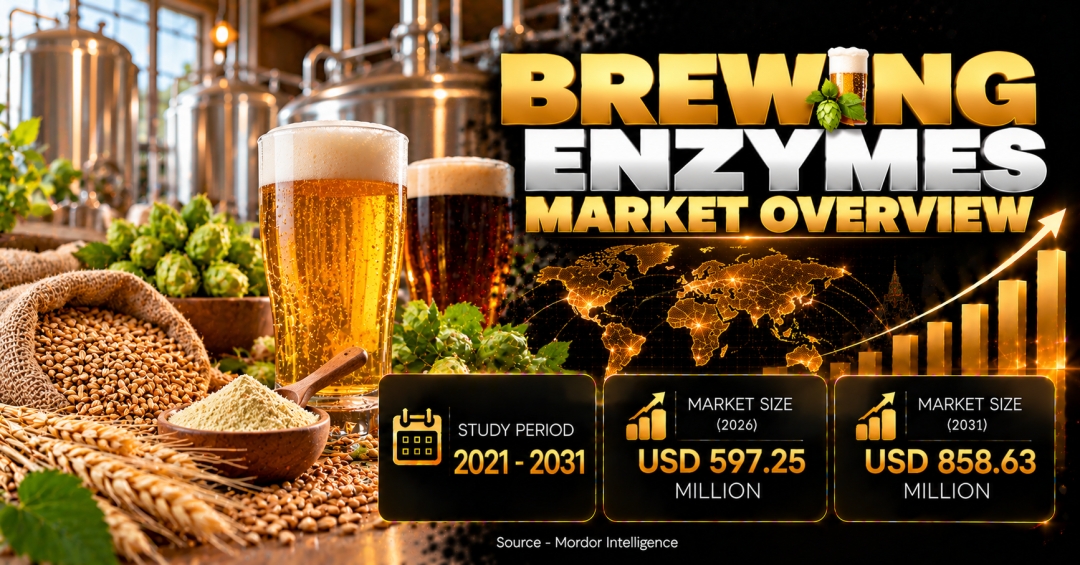
Hyderabad, October 29, 2026: According to Mordor Intelligence, the brewing enzyme market size is expected to grow from $597.25 million in 2026 to reach $858.63 million by 2031, registering a CAGR of 7.54% during the forecast period (2026-2031). The market continues to expand as industrial beverage corporations, commercial craft breweries, and boutique brewpubs prioritize biological biocatalysts to accelerate mashing throughput, improve starch conversion, and optimize fermentation yields. Accelerating global demand for premium beers, the proliferation of independent microbreweries, and the rising consumer adoption of functional, low-alcohol, and gluten-free beverages continue to support demand across commercial breweries and winemaking facilities worldwide.
Brewing Enzymes Market Trends
Expansion of Craft Breweries and Specialty Formulations Drives Enzyme Demand
One of the leading brewing enzyme market trends is the worldwide proliferation of independent craft breweries, microbreweries, and brewpubs. Craft brewers increasingly utilize targeted enzyme solutions to overcome batch-to-batch variations in raw grain quality, enhance hop utilization, and develop complex flavor profiles. In addition, changing lifestyle habits have accelerated consumer interest in specialty craft beverages, including gluten-reduced beers and non-alcoholic malt beverages. Specialized endo-proteases and exogenous glucanases enable brewmasters to break down haze-forming proteins and gluten peptides efficiently, ensuring product clarity and digestive compliance. This expansion of artisanal beverage portfolios continues to support the brewing enzyme industry.
High-Gravity Brewing and Local Adjunct Utilization Enhance Facility Efficiency
Industrial brewing facilities are increasingly adopting high-gravity brewing techniques to maximize brewhouse vessel output without expanding fermentation tank footprints. High-gravity mashing creates dense worts that require supplemental amylases and beta-glucanases to lower wort viscosity, prevent filter-bed blinding, and accelerate filtration run-off times. Furthermore, breweries in emerging regions rely on tailored enzyme blends to substitute costly malted barley with unmalted local adjuncts such as corn, rice, cassava, or sorghum. These processing solutions reduce grain transportation logistics while maintaining target alcohol yields, aligning with broader formulation standards seen across the integrated food ingredients industry for cost-efficient raw material utilization.
Microbial Sourcing Dominates Commercial Enzyme Output
Source selection remains an essential development area across the brewing enzyme market growth. Microbial-derived enzymes account for the largest share within the brewing enzyme market, capturing over 70% of total consumption. Industrial fermentation using bacterial and fungal strains like Bacillus and Aspergillus species provides scalable production volumes, consistent batch purity, and high enzymatic activity compared to plant-extracted alternatives. Concurrently, microbial enzymes exhibit superior thermo-stability during industrial decoction mashing, ensuring precise liquefaction and saccharification even under variable pH and temperature profiles.
Beer Brewing Represents Primary Volume While Enology Expands High-Value Niches
Application sectors continue to play a decisive role across modern brewing enzyme market trends. Beer manufacturing represents the foundational volume driver, accounting for over 85% of total enzyme demand due to large-scale mashing, clarification, and cold-stabilization requirements in industrial lager production. Simultaneously, commercial wine production represents the fastest-growing application segment. Winemakers utilize specialized pectinases and glycosidases to enhance grape juice extraction, accelerate must settling, clarify juices, and liberate aroma-precursor terpenes. These enological applications help wineries optimize vintage yields and improve aromatic expressiveness.
Europe Retains Regional Revenue Leadership While Asia-Pacific Leads Growth Pace
Regional production and consumption dynamics continue to influence the brewing enzyme market forecast. Europe commands the largest regional market share, supported by traditional brewing heritage in Germany, Belgium, and the United Kingdom, high per capita beer consumption, and rigorous manufacturing efficiency benchmarks. Meanwhile, the Asia-Pacific region represents the fastest-growing market, propelled by rapid brewery modernization, rising disposable incomes, expanding urban populations, and increasing premium beer intake across China, Japan, Vietnam, and India. Evolving consumer drinking preferences continue to create new opportunities for producers expanding their regional presence.
Check out more details and stay updated with the latest industry trends, including the Japanese version for localized insights: https://www.mordorintelligence.com/ja/industry-reports/brewing-enzymes-market?utm_source=abnewswire
Brewing Enzymes Market Segmentation
By Type
- Amylase
- Alphalase
- Beta Glucanase
- Protease
- Others (Pectinase, Xylanase, Cellulase)
By Source
- Microbial
- Plant
By Form
- Dry (Powder/Granules)
- Liquid
By Application
- Beer
- Wine
By Geography
- North America
- Europe
- Asia-Pacific
- South America
- Middle East and Africa
Competitive Landscape of the Brewing Enzymes Industry
The brewing enzyme industry exhibits a moderate level of market concentration, with multinational life-science corporations, industrial biotechnology groups, and specialized fermentation ingredient suppliers competing across biocatalytic specificity, technical field support, and global supply networks. Market leaders are strengthening their market presence by constructing dedicated enzyme fermentation facilities, expanding certified non-GMO and kosher portfolios, and offering customized technical consulting to optimize brewhouse operations.
Enzyme stability, substrate specificity, and residue-free filtration continue to be critical areas of differentiation as suppliers invest in protein engineering and advanced downstream purification to ensure enzymes deactivate cleanly during boiling. Businesses are also refining technical service partnerships with multinational brewing conglomerates, regional craft brewing guilds, and commercial winemaking enterprises to assist with recipe redesign. These initiatives are helping companies protect their brewing enzyme market share while maintaining quality consistency across global distribution networks.
Regional expansion also remains an important business strategy. Leading enzyme producers continue to establish regional application laboratories near emerging brewing centers, build localized liquid formulation plants, and train brewmasters on high-gravity adjunct conversion. As global commercial demand for cost-efficient, sustainable brewing processes continues to rise, the brewing enzyme market forecast remains supported by ongoing investments in precision fermentation, clean-label biological tools, and international brand partnerships.
Key Players
Major companies operating in the brewing enzyme market include:
- Amano Enzyme Inc.
- Associated British Foods plc
- DuPont de Nemours, Inc.
- DSM-Firmenich
- Novozymes A/S
Conclusion
The brewing enzyme market forecast remains positive as commercial beverage producers and craft brewers worldwide continue adopting targeted biocatalysts that maximize extract yield, reduce carbon emissions, and expand specialty product lines. Enzyme manufacturers and biotechnology specialists are responding by expanding customized microbial blends, refining thermo-tolerant enzymes for high-gravity brewing, and developing pectinase solutions that elevate sensory nuances in wine and craft ales. These developments are expected to support continued demand across multiple commercial brewing, craft, and winemaking channels.
Regional opportunities also remain strong. Europe provides an established, high-volume commercial baseline, while Asia-Pacific offers attractive growth pathways as industrial brewery modernization and craft beer adoption accelerate enzyme consumption across rapidly growing urban centers. This shift is expected to create new commercial avenues for enzyme producers expanding their operational footprint in developing markets.
Overall, the brewing enzyme market size is expected to benefit from changing consumer drinking preferences, growing demand for resource-efficient brewing methods, wider availability across industrial processing networks, and an ongoing commitment to precision biocatalysis. Together, these factors are expected to support sustained brewing enzyme market growth while strengthening the long-term outlook for the global brewing enzyme industry.
Industry Trending Reports
Brewery Equipment Market: The global brewery equipment market is projected to expand from $23.62 billion in 2026 to $32.69 billion by 2031, achieving a 6.71% CAGR. Market expansion is driven by craft and macro-brewers investing in energy-efficient, automated brewhouses that support flexible multi-recipe batching and stringent automated sanitation protocols. While mature European operations focus capital expenditure on retrofitting sustainable boiling and heat-recovery modules, emerging regions are scaling turnkey greenfield installations engineered for modular volume expansion and adaptable packaging lines.
Cold Brew Coffee Market Size: The global cold brew coffee market is estimated at $3.79 billion in 2026 and is forecast to climb to $8.36 billion by 2031, registering a 17.12% CAGR. Category acceleration is propelled by younger demographics migrating toward slow-extracted, low-acidity single-origin profiles and portable ready-to-drink (RTD) aluminum cans across retail convenience networks. While North America anchors dominant revenue share, the Asia-Pacific region is experiencing the fastest expansion, prompting brand owners to formulate functional variants infused with plant proteins, adaptogens, and clean-label botanical extracts.
Food Enzymes Market in Mexico Share: The food enzymes market in Mexico is valued at $160.25 million in 2026 and is projected to reach $228.76 million by 2031, growing at a 7.38% CAGR. Growth is sustained by Mexico’s expanding role as a major food-processing corridor, where industrial bakeries, dairy processors, and beverage bottlers utilize specialty enzymes for clean-label shelf-life extension, sugar reduction, and dough conditioning. As compliance with COFEPRIS standards tightens, multinational ingredient suppliers are scaling domestic blending capacity and deploying precision fermentation to deliver cost-competitive alternatives to chemical emulsifiers.
About Mordor Intelligence:
Mordor Intelligence is a global market intelligence firm, founded in 2014, helping businesses make informed decisions through data-driven insights, industry expertise, and advanced analytics. With 550+ domain experts and on-ground specialists across 150+ countries, the company delivers comprehensive intelligence across aerospace & defense, agriculture, automation, automotive, chemicals & materials, consumer goods & services, electronics, energy & power, financial services, food & beverages, healthcare, hospitality & tourism, information & communications technology, and logistics.
Its offerings include syndicated industry reports, custom research and advisory, and subscription platforms such as Synapse, Data Center Intelligence, and Robotics Intelligence. Mordor Intelligence is ISO 9001:2015 and ISO/IEC 27001:2022 certified, a member of ESOMAR and the Market Research Society of India, and a four-time Great Place to Work® honoree.;
Media Contact
Company Name: Mordor Intelligence
Contact Person: Jignesh Thakkar
Email: Send Email
Phone: +1 617-765-2493
Address:11th Floor, Rajapushpa Summit, Nanakramguda Rd, Financial District, Gachibowli media@mordorintelligence.com
City: Hyderabad
State: Telangana 500008
Country: India
Website: https://www.mordorintelligence.com/industry-reports/brewing-enzymes-market?utm_source=abnewswire


