
Sjogren’s Syndrome Market Size in the 7MM is projected to grow at a significant CAGR over the forecast period of 2026-2036 | DelveInsight
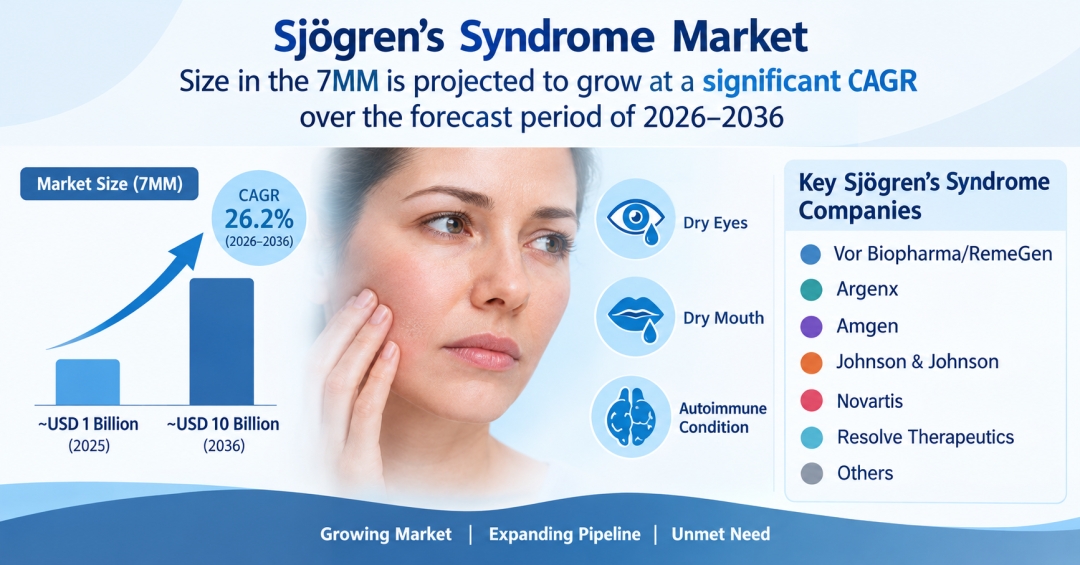
(Albany, US), October 24, 2026 – DelveInsight’s “Sjögren’s Disease Market Insights, Epidemiology, and Market Forecast – 2036” report delivers an in-depth understanding of Sjögren’s disease, historical and forecasted epidemiology, as well as the Sjögren’s disease market trends in the United States, EU4 (Germany, France, Italy, and Spain), the United Kingdom, and Japan.
Explore the intricate details of the Sjogren’s Syndrome Market Report @ Sjogren’s Syndrome Market Size
Key Takeaways from the Sjogren’s Syndrome Market Report
-
In June 2026, Johnson & Johnson reported new exploratory biomarker analyses from the Phase II DAHLIAS study evaluating nipocalimab in adults with moderate-to-severe Sjögren’s disease. The findings showed that participants with elevated autoantibody and immunoglobulin G (IgG) levels, who often experience a greater disease burden, demonstrated higher clinical response rates.
-
In April 2026, Novartis reported that ianalumab had received FDA Priority Review, with regulatory submissions completed in the US, Europe, and Japan, marking the program’s progression into global regulatory review.
-
According to DelveInsight’s analysis, the Sjögren’s disease market size was around USD 1 billion in the 7MM in 2025 and is projected to reach ~USD 10 billion by 2036, growing at a CAGR of 26.2% during 2026-2036.
-
In 2025, the total number of diagnosed prevalent cases of Sjögren’s disease in the 7MM was more than 1 million, with the US accounting for the highest number of diagnosed prevalent cases.
-
In 2025, the Sjögren’s disease market size in the US was nearly USD 700 million, and this figure is expected to grow significantly with the introduction of emerging therapies.
-
Sjögren’s disease represents a major unmet opportunity in immunology, with no approved disease-modifying therapies and current care largely limited to symptomatic relief.
-
Generic pilocarpine (SALAGEN) and cevimeline (EVOXAC) primarily alleviate dry-mouth symptoms but do not modify disease progression, leaving a significant gap for therapies.
-
The Sjögren’s disease treatment pipeline is increasingly diversified, encompassing B-cell depletion, BAFF/APRIL modulation, FcRn blockade, and T-cell–B-cell interaction inhibition.
-
The leading Sjogren’s Syndrome Companies include Vor Biopharma/RemeGen, Argenx, Amgen, Johnson & Johnson, Novartis, Resolve Therapeutics, and others.
-
Promising Sjogren’s Syndrome Therapies include Telitacicept (RC18), Dazodalibep, Nipocalimab (IMAAVY), Ianalumab (VAY736), RSLV-132, and others.
Get a Free sample for the Sjogren’s Syndrome Market Forecast, Size & Share Analysis Report @ Sjogren’s Syndrome Therapeutics Market
Sjogren’s Syndrome Overview
Sjögren’s disease, previously referred to as Sjögren’s syndrome, is a chronic, systemic autoimmune disorder in which the body’s immune system mistakenly targets its own exocrine glands, particularly the lacrimal (tear) glands and salivary glands. This immune-mediated attack results in lymphocytic infiltration and progressive damage to glandular tissue, impairing the glands’ ability to produce adequate moisture. The diagnosis of Sjögren’s disease remains challenging due to its heterogeneous presentation, overlapping autoimmune symptoms, and absence of a single definitive diagnostic test. Persistent sicca symptoms, anti-Ro/SSA antibody testing, Schirmer’s test, ocular staining, and salivary gland biopsy support disease identification under the 2016 ACR/EULAR classification criteria. Improved physician awareness and serological testing may enhance diagnosis, while seronegative and systemic cases continue to contribute to diagnostic delays and an unmet need for timely treatment.
Sjogren’s Syndrome Epidemiology Segmentation in the 7MM
-
Total Diagnosed Prevalent Cases of Sjögren’s Disease
-
Type-specific Diagnosed Prevalent Cases of Sjögren’s Disease
-
Gender-specific Cases of Sjögren’s Disease
-
Antibody-specific Cases of Sjögren’s Disease
-
Severity Specific Distribution (ESSDAI Score)
-
Treated Cases of Sjögren’s Disease
Download the report to understand which factors are driving Sjogren’s Syndrome Epidemiology trends @ Sjogren’s Syndrome Prevalence
Sjogren’s Syndrome Epidemiology Key Findings
-
In the US, total diagnosed prevalent cases of Sjögren’s disease were approximately 730,000 in 2025, supported by improved recognition of patients presenting with persistent sicca symptoms and the increasing adoption of serological testing.
-
Gender-specific diagnosed prevalent cases in the US in 2025 were predominantly female, accounting for more than 650,000 cases, compared with around 75,000 male cases, reflecting the disease’s established female predominance.
-
In 2025, Anti-Ro/SSA-positive cases represented the largest antibody-specific segment across EU4 and the UK, totaling approximately 410,000 cases, followed by Anti-La/SSB-positive cases at around 290,000.
-
Japan recorded approximately 120,000 diagnosed prevalent cases in 2025, of which nearly 82,000 were mild cases, while around 35,000 were moderate-to-severe cases.
Current Treatment Landscape for Sjogren’s Syndrome
The Sjögren’s disease treatment landscape is primarily supported by local symptomatic therapies, including pilocarpine, cevimeline, and topical ocular treatments, alongside systemic therapies such as corticosteroids, hydroxychloroquine, and conventional immunosuppressants. In the absence of an FDA-approved disease-specific treatment, management remains individualized according to symptom burden, disease severity, and extra-glandular involvement. Systemic therapies are reserved for patients experiencing inflammatory musculoskeletal symptoms or clinically significant organ involvement. Although off-label biologics such as rituximab are used in selected refractory cases, variable clinical outcomes and limited disease-specific evidence continue to constrain treatment standardization and highlight the reliance on symptom- and organ-directed management.
Sjogren’s Syndrome Pipeline Analysis
-
Ianalumab (VAY736): Novartis
Ianalumab (VAY736) is a novel, fully human monoclonal antibody of the IgG1/κ-class, directed against B cells and binding to the B-cell activating factor receptor (BAFF-R). It is designed with a dual mechanism of action, combining B-cell depletion via antibody-dependent cellular cytotoxicity (ADCC) with interruption of BAFF-R-mediated signals that support B-cell function and survival. In April 2026, Novartis reported that ianalumab had received FDA Priority Review, while regulatory submissions had been completed in the US, Europe, and Japan. In July 2026, Novartis reported that longer-term data from NEPTUNUS-1 and NEPTUNUS-2 showed durable ESSDAI improvement and a favorable safety profile with no increase in TEAE rates through Week 108. The anticipated launch in the US is 2027.
-
Nipocalimab (IMAAVY): Johnson & Johnson
Nipocalimab is an FcRn antagonist being developed by Johnson & Johnson for Sjögren’s disease and is in Phase III, administered as IV infusion/SC. In June 2026, Johnson & Johnson reported new biomarker exploratory analyses from the Phase II DAHLIAS study in adults with moderate-to-severe Sjögren’s disease, showing that participants with elevated autoantibody and immunoglobulin G (IgG) levels, who often experience more substantial disease burden, had greater clinical response rates.
Discover more about therapies set to grab Major Sjogren’s Syndrome Market Share @ Sjogren’s Syndrome Market Drivers and Barriers
Sjogren’s Syndrome Market Outlook
At present, the therapeutic market size of Sjögren’s disease is mainly accounted for by local therapies, systemic therapy, and biological therapies. Local therapies mainly include pilocarpine, cevimeline, topical fluoride, topical cyclosporine, autologous serum eye drops, and others, while systemic therapy mainly uses corticosteroids, hydroxychloroquine, and immunosuppressants. In the absence of an approved disease-specific treatment, management primarily relies on individualized symptom control and organ-directed immunosuppression.
Biologics are emerging as a key therapeutic class, driven by the need for targeted disease-modifying therapies that address underlying B-cell hyperactivity, autoantibody production, and immune dysregulation beyond symptomatic management. Agents such as ianalumab (VAY736), a B-cell-depleting anti-BAFF-R monoclonal antibody, and dazodalibep, a CD40 ligand (CD40L) antagonist, represent distinct approaches to modulating pathogenic immune pathways. Ianalumab has emerged as a key late-stage candidate after meeting primary endpoints in the Phase III NEPTUNUS-1 and NEPTUNUS-2 studies, while nipocalimab has demonstrated reductions in clinical systemic disease activity and dose-dependent decreases in total IgG and Sjögren’s disease-associated autoantibodies.
-
The total market size of EU4 and the UK was estimated at approximately USD 300 million in 2025.
-
Among EU4 and the UK, Germany accounted for the highest market share with approximately USD 150 million in 2025, followed by the UK with approximately USD 60 million, while France captured the least with nearly USD 10 million.
-
In 2025, the total market size of Sjögren’s disease was more than USD 30 million in Japan, which is anticipated to increase during the forecast period (2026–2036).
Sjogren’s Syndrome Unmet Needs and Treatment Gaps
Despite Sjögren’s syndrome being a systemic autoimmune disease, treatment remains heavily focused on managing individual manifestations such as ocular and oral dryness, while systemic immunomodulators are largely used off-label. Key unmet needs include the lack of an approved systemic disease-modifying therapy, a high-burden population that remains inadequately served, insufficient addressal of severe systemic and extraglandular manifestations, and fragmented epidemiological evidence that limits confidence in the true addressable population. Recent clinical development has begun to demonstrate that disease-modifying approaches may be feasible, increasing the competitive importance of establishing a clearly differentiated mechanism and clinically meaningful benefit.
To know more about Sjogren’s Syndrome Companies working in the treatment market, visit @ Sjogren’s Syndrome Market Access and Reimbursement
Scope of the Sjogren’s Syndrome Market Report
-
Coverage- 7MM
-
Study Period- 2022-2036
-
Forecast Period- 2026-2036
-
Sjogren’s Syndrome Companies- Vor Biopharma/RemeGen, Argenx, Amgen, Johnson & Johnson, Novartis, Resolve Therapeutics, and others.
-
Sjogren’s Syndrome Therapies- Telitacicept (RC18), Dazodalibep, Nipocalimab (IMAAVY), Ianalumab (VAY736), RSLV-132, and others.
-
Sjogren’s Syndrome Market Dynamics: Sjogren’s Syndrome market drivers and market barriers
-
Sjogren’s Syndrome Competitive Intelligence Analysis: SWOT Analysis, Attribute Analysis
-
Sjogren’s Syndrome Unmet Needs, KOL Views, Reimbursement
Table of Contents
-
Key Insights
-
Report Introduction
-
Executive Summary
-
Key Events
-
Epidemiology and Market Forecast Methodology
-
Sjögren’s Disease Market Overview at a Glance
-
Disease Background and Overview
-
Epidemiology and Patient Population
-
Patient Journey
-
Emerging Drugs
-
Sjögren’s Disease: The 7MM Analysis
-
Unmet Needs
-
SWOT Analysis
-
KOL Views
-
Market Access and Reimbursement
-
Appendix
-
DelveInsight Capabilities
-
Disclaimer
-
About DelveInsight
Media Contact
Company Name: DelveInsight Business Research LLP
Contact Person: Abhishek kumar
Email: Send Email
Phone: +19193216187
Address:304 S. Jones Blvd #2432
City: Albany
State: New York
Country: United States
Website: https://www.delveinsight.com/sample-request/sjogrens-syndrome-market-size


