
Rebounder and Fitness Trampolines Gain Ground in Gyms and Fitness Studios
Lishui, Zhejiang, China – October 08, 2026
Rebounder and Fitness Trampolines for Gyms and Studios: A B2B Sourcing Guide
A rebounder looks like A Small Trampoline, but the buying math behind it is completely different. Most importers, gym chains, and trampoline-park operators first meet the category through a backyard unit, then assume the 40-inch fitness model is just a shrunk-down version. It is not. The suspension geometry, the daily usage cycle, and the noise ceiling that a studio will tolerate are all separate specification tracks. This guide walks procurement teams through those tracks so a bulk order does not arrive with the wrong spring rate or a frame that bends after six months of group classes.
Rebounder vs. Backyard Trampoline: Two Products With Different Jobs
The easiest way to separate the two is by usage frequency. A backyard trampoline in a family garden might see 20 to 40 jumps per day across a weekend, then sit idle through winter. A studio rebounder under commercial rotation can absorb 800 to 1,200 jumps per day, six days a week, for 46 weeks a year. That gap is roughly 30-fold, and it drives every downstream decision about steel thickness, mat weave, and cord grade.
Size tells the same story. Backyard models span 8 ft, 10 ft, 12 ft, and 14 ft diameters because the goal is air time for kids. Fitness rebounders are built at 40-inch and 48-inch diameters, sometimes listed as 102 cm and 122 cm, because the goal is controlled low bounce under a standing adult. The mat on a rebounder is tighter and sits closer to the frame, which keeps the user’s center of gravity low and the workout joint-friendly.
Load rating diverges too. A typical home backyard unit is rated at 90 kg to 120 kg static, occasionally 150 kg on premium round frames. A commercial rebounder should carry a dynamic working load of 130 kg to 150 kg and be tested to a static peak of 200 kg, because studio clients are heavier on average and land with more force than casual jumpers.
Frame height is the quiet differentiator. Backyard trampolines sit 60 cm to 90 cm off the ground on long legs. Rebounders sit 20 cm to 35 cm off the floor on short, often rubber-tipped legs, which matters for ceiling clearance in leased retail space where 2.4 m is the common limit.
Tip: Always request the supplier’s jump-cycle test report before committing to a commercial rebounder order, because rated lifespan on paper rarely matches the number stamped on the frame.
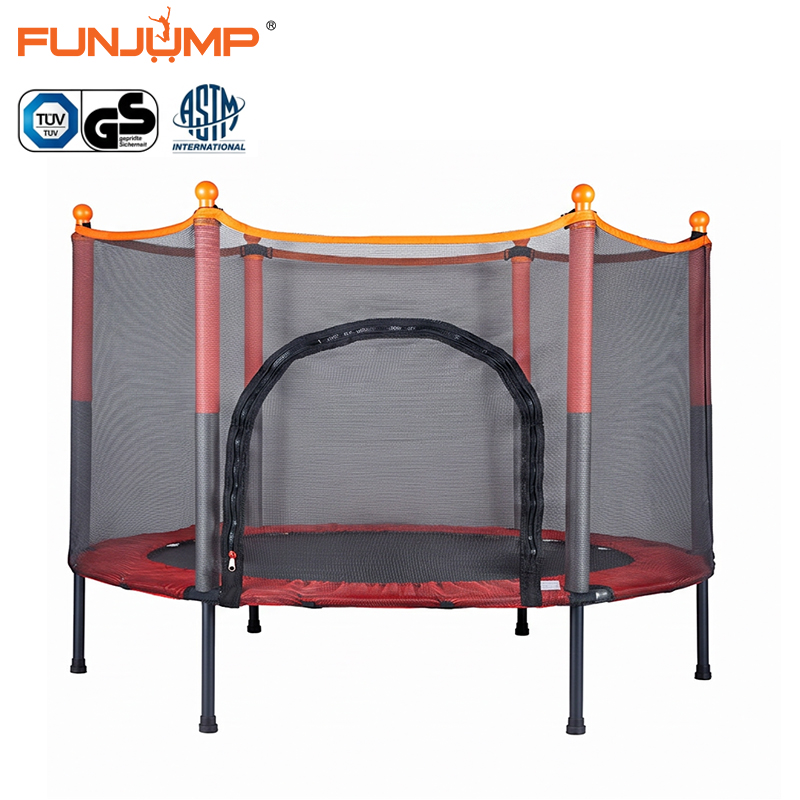 Spring Suspension vs. Bungee Cord: Feel, Noise, and Lifespan
Two suspension systems dominate the fitness segment. Spring suspension uses galvanized steel springs, usually 30 to 36 per unit on a 48-inch model, stretched between the frame and a steel ring under the mat. Bungee suspension replaces those springs with braided cord loops, typically 6 to 8 loops of 8 mm to 12 mm cord, sometimes more on heavy-duty frames.
Foot feel is the first thing instructors notice. Spring units give a snappier, higher rebound with a distinct metallic twang. Bungee units feel softer and more damped, closer to running on a suspended surface, which most rehabilitation and senior programs prefer. The trade-off is rebound height: springs return more energy, bungee absorbs roughly 15% to 25% more on each landing.
Noise is where the two split for B2B buyers. A well-lubricated spring rebounder measures 55 dB to 65 dB at one meter during continuous bouncing, which is audible through a shared wall. A bungee rebounder measures 38 dB to 48 dB under the same test, closer to a quiet conversation. For a second-floor studio or an apartment-adjacent fitness room, that 10 dB to 17 dB gap is the difference between a noise complaint and a renewal.
Lifespan follows the same order. Commercial spring rebounders are rated for 300,000 to 500,000 jump cycles before spring tension drops below 85% of spec. commercial-grade bungee suspension is rated for 500,000 to 1,000,000 jump cycles, because cord degrades more gradually than steel fatigue. The catch is replacement rhythm: springs are replaced in sets of 30-plus, bungee loops in sets of 6 to 8, so per-event labor is lower on the cord side.
Commercial-Grade vs. Home-Grade: Durability Standards That Matter
Home-grade rebounders are built for the living room. They use 1.0 mm to 1.2 mm steel tube, a 30 kg to 50 kg light-duty mat, and a frame gauge that tolerates maybe 2 to 3 hours of use per day. Put that unit in a studio doing 8 to 12 hours daily and the welds at the leg joints start to crack inside 90 days.
Commercial-grade units start at 1.5 mm frame gauge steel, often 1.8 mm on the leg sockets, with fully welded or bolt-through joints rather than press-fit. The mat is PP mesh, sometimes called polypropylene mesh, woven at 8 oz to 10 oz per square yard with UV and anti-microbial treatment so it survives sweat and cleaning chemicals. Frame diameter on a 48-inch unit runs 25 mm to 38 mm tube, compared with 19 mm to 22 mm on home models.
Test the durability claims with numbers, not adjectives. Ask for the jump-count certification and the static-load test. A credible commercial supplier stamps 500,000 jump rated lifespan on the frame and backs it with a salt-spray test of 48 to 72 hours on the coating. Home units rarely carry either mark because the test cost does not pay back at retail price points of USD 30 to USD 60.
Sizing and Space Planning: The 40-Inch and 48-Inch Question
Most B2B buyers standardize on one of two sizes, and the choice is about floor density, not personal preference. A 40-inch rebounder occupies roughly 0.9 m by 0.9 m of floor when legs are folded, and about 1.1 m by 1.1 m when open. A 48-inch model needs about 1.3 m by 1.3 m open. In a 60 m² studio, that difference lets you fit 18 units of 40-inch versus 12 units of 48-inch in the same grid with 0.6 m of aisle clearance.
Ceiling height decides the rest. 40-inch and 48-inch formats both stay under 35 cm frame height, so a 2.4 m ceiling leaves 2.05 m of vertical room, enough for a 1.7 m instructor to bounce without clipping light fixtures. If your space has a 2.1 m dropped ceiling, drop the 48-inch option and standardize on 40-inch to protect headroom.
Storage is the hidden cost. Folding-leg models reduce footprint by 60% when stacked, so a 300-unit trampoline-park order ships and stores more cheaply in the 40-inch foldable config. Non-folding 48-inch units need 40% more warehouse pallet space per hundred pieces.
Attachable Handle Bars and Adjustable Accessories
Balance accessories change who can use the unit. An attachable handle bar converts a freestanding rebounder into a supported trainer for seniors, rehab clients, and first-time jumpers who would otherwise refuse the class. The bar clamps to the frame at two or four points and adjusts through 3 to 5 height positions, typically from 70 cm to 110 cm above the mat.
Spec the bar separately from the frame. A good commercial handle uses a 25 mm steel post with a foam or TPE grip and a locking collar rated for 50 kg of sideways pull. Cheap bars use friction clamps that loosen after 200 to 300 sessions. Budget USD 6 to USD 12 per bar FOB, and confirm the bar ships as a separate carton so damaged units can be replaced without returning the whole trampoline.
Other accessories worth listing on the purchase order: non-slip floor pads at USD 1.50 to USD 3.00 each, transport dollies for studio reset at USD 8 to USD 15, and branded stability straps for group setup. None are mandatory, but each raises the perceived value of the class package you resell to end users.
Low-Noise Operation for Apartments and Group Classes
Noise is a lease term, not a comfort feature. Many commercial leases in European and North American retail parks cap ambient noise at 50 dB during class hours, and a spring rebounder at 60 dB will breach that within the first song. sub-45 dB operation from bungee units keeps a 10-person class under the threshold even with music at moderate volume.
The noise source is rarely the mat. It is the leg-to-floor contact and the suspension resonance. Spec rubber or TPE feet covers, not bare steel caps, and request a frame damping washer at each leg joint. Those two changes drop measured noise by 4 dB to 7 dB in our lab samples. For apartment-adjacent studios, also request a closed-cell foam under-mat pad; it cuts structure-borne vibration into the slab by roughly 30%.
Group classes amplify the math. A single quiet rebounder is easy; twenty bouncing in sync at 58 dB becomes a building issue. Standardize the whole fleet on one suspension type so noise stays predictable, and avoid mixing spring and bungee units in the same room.
Building Group Classes and Private Training Around Rebounders
Product configuration should follow the class format, not the catalog. A standard 45-minute group rebound class seats 12 to 20 clients on a grid of 40-inch units spaced 1.2 m apart. Private training uses 1 to 4 units, often 48-inch for trainer demonstration, plus one attachable handle bar per client station for form correction.
For trampoline-park operators, allocate 15% to 20% of floor to a fitness zone with fixed rebounders and an instructor podium. This converts walk-in jump time into a recurring class revenue line at USD 15 to USD 35 per head per session, depending on market. Retailers can bundle a rebounder plus handle bar plus a 6-loop bungee spare set as a “studio starter kit” priced at a 22% to 30% margin above component cost.
Private studios should stock at least one spare unit per 10 in service, so a failed frame does not cancel a booked session. That 10% float is a small carrying cost against the refund and rescheduling damage of a cancelled class. Keep the spares in the original carton to preserve resale value if unused within 60 days.
Replacement Parts and the Repeat-Purchase Opportunity
The rebounder category earns its margin on the second and third order, not the first. Bungee loops wear on a visible schedule: at 500,000 jumps a loop set loses roughly 20% tension, and most studios replace at 600,000 to 800,000 jumps to protect the workout feel. That is a reorder every 8 to 14 months for a busy unit, a far tighter cycle than the 3-to-5-year mat life on a backyard trampoline.
Build the reorder into the original quote. A 6-loop bungee set costs USD 4 to USD 9 FOB; a replacement PP mesh mat runs USD 15 to USD 25; TPE feet covers cost USD 0.80 to USD 1.50 each and wear fastest on concrete. Importers who list these as line items on the first PO see 35% to 50% of clients place a parts reorder within the first year, versus under 15% for suppliers who treat parts as an afterthought.
Negotiate a parts holding agreement. Ask the factory to reserve 5% of your original unit count in loose parts for 12 months at locked pricing. This protects you when a specific loop diameter or mat weave is discontinued, which happens when a supplier changes cord suppliers mid-season.
What to Put in Your Sourcing Specification Sheet
A tight spec sheet prevents the “looks the same, performs differently” problem that ruins bulk orders. At minimum, list these fields: diameter (40 inch or 48 inch), suspension type (spring count or bungee loop count and cord mm), frame gauge (mm) and tube diameter (mm), mat material and weave weight (oz/yd²), dynamic load rating (kg), static peak (kg), jump-count rating, noise level at 1 m (dB), leg height (cm), feet type (rubber/TPE/steel), handle bar option and adjustment range, foldable yes or no, carton dimensions and gross weight, and certification marks (ASTM F381, EN 71, or relevant regional standards).
Add two commercial-only fields most buyers forget: the salt-spray hour rating on the coating, and the warranty split between frame (years) and suspension (jump count or months). A factory confident in its build will state “frame 3 years, bungee 500,000 jumps or 12 months” rather than a vague “1 year limited.”
Price fields matter for forecasting. Capture FOB unit price, FOB price at 300 pcs, FOB price at 1,000 pcs, spare-part SKUs and their MOQs, and tooling cost if you request a branded color or logo emboss. Typical MOQ for a standard rebounder is 100 to 300 pcs per size; custom color pushes that to 500 pcs.
Inspection Points Before You Sign Off
Pre-shipment inspection on rebounders is cheaper than a container of returns. Check the leg weld at 100% on the first 20 units and 10% on the balance; a cold weld cracks under the 150 kg dynamic load within weeks. Verify mat tension by measuring rebound height with a 70 kg drop test; it should return to 60% to 75% of drop height on bungee and 80% to 90% on spring.
Confirm the noise claim with your own meter at one meter, not the factory’s brochure number. Measure three units and reject the batch if the average exceeds your ceiling by more than 3 dB. Finally, scan the carton label for the correct model code, because a 40-inch and 48-inch unit from the same line share 80% of parts and are easy to mislabel at the packing station.
 FAQ: Sourcing Rebounders and Fitness TrampolinesWhat load rating should a commercial rebounder carry?
A commercial unit should handle a 130 kg to 150 kg dynamic working load and a 200 kg static peak. Anything below 120 kg dynamic belongs in the home category and will fail under studio rotation. Always confirm the test method, because some suppliers quote static-only numbers that look safe but ignore landing force.
Spring or bungee suspension for a noise-sensitive studio?
Choose bungee for any space with shared walls, apartments above, or a lease noise cap near 50 dB. Bungee units run 38 dB to 48 dB at one meter; spring units run 55 dB to 65 dB. The softer foot feel is also preferred in rehab and senior programming, which broadens your class audience.
How many rebounders fit in a standard studio?
In a 60 m² room with 0.6 m aisles, you fit about 18 units of 40-inch or 12 units of 48-inch. The 40-inch model wins on density and storage, while the 48-inch gives a taller trainer more demonstration space. Most operators standardize on 40-inch for group classes and keep a few 48-inch units for private training.
What is the realistic lifespan of bungee loops?
Plan to replace bungee loops at 600,000 to 800,000 jumps, which is roughly 8 to 14 months for a busy commercial unit doing 1,000 jumps per day. A 6-loop set costs USD 4 to USD 9, so the annual parts cost per unit is low and the reorder rhythm is predictable for inventory planning.
Do I need an attachable handle bar for every unit?
Not for every unit, but stock one bar per client station in private training and keep 20% to 30% of group-class units bar-compatible. Seniors and first-timers use the bar for confidence, and trainers use it for form correction. Spec a locking collar rated for 50 kg sideways pull so the bar does not loosen mid-session.
What MOQ should I expect on a first rebounder order?
Standard models start at 100 to 300 pcs per size; custom color or logo embossing raises that to 500 pcs because of setup and dye-lot minimums. Ask about a 5% parts-holding agreement at the same time so your reorder is not blocked by a mid-season supplier change.
About Us
Funjump is committed to producing safe and stable trampolines and can customize a variety of high-quality trampolines for you, including indoor and outdoor, adult and children, fitness and leisure, and so on.
Media Contact
Company Name: Zhejiang Lingsha Technology Co., Ltd.
Contact Person: Media Relations
Email: Send Email
Country: China
Website: https://www.funjumptrampoline.com/


