
Remote Monitoring: The Next Practical Step for Autonomous Agriculture
Xi’an, Shaanxi, China – September 30, 2026
When the Machine Can Work by Itself, What Should the Farmer Do?
Agricultural automation has traditionally focused on making machines perform individual tasks automatically. A machine can follow a planned route, maintain accurate positioning, detect obstacles, and control its movement without continuous steering.
But there is another question that becomes increasingly important as autonomous technology develops: Does someone still need to stay beside the machine throughout the operation?
If the answer is always yes, automation can reduce some manual work, but its potential remains limited. The operator may no longer need to steer continuously, yet still needs to remain nearby and watch the machine.
Remote monitoring changes this relationship. Instead of spending hours directly operating the machine, the user can monitor the operation, receive information about the machine’s status, and intervene when necessary. The role gradually shifts from continuously controlling the machine to managing the overall operation.
Automation Is More Than Driverless Movement
A truly useful autonomous agricultural machine needs more than the ability to move without a driver.
It needs to know where it is, understand the planned route, execute the task correctly, and respond appropriately when conditions change. Positioning, navigation, machine control, safety systems, and communication all need to work together.
This is especially important in agriculture because working environments are rarely perfectly controlled.
Fields and orchards can have uneven terrain, changing soil conditions, obstacles, narrow working spaces, and different working patterns. A machine that works well during a short demonstration still needs to be reliable when used for hours in a real agricultural environment.
That is why remote monitoring is becoming an important part of the wider autonomous system.
From Operating a Machine to Managing an Operation
Consider a routine orchard operation.
Traditionally, an operator may need to drive the machine along every row, continuously control its direction, monitor the equipment, and make small corrections throughout the process.
With a more autonomous system, many of these repetitive actions can be handled by the machine.
The operator’s role becomes different.
Instead of focusing on every movement, the operator can pay more attention to the task itself: where the machine needs to work, what operation is being performed, whether the equipment is functioning normally, and whether intervention is required.
This does not mean that people disappear from the process. Rather, human involvement moves to a higher level.
The machine handles repetitive execution. The human remains responsible for supervision, decisions, and overall management.
Why Remote Monitoring Matters in Real Farming
The value of remote monitoring becomes clearer when operations last for several hours. Agricultural work is often repetitive. Mowing, spraying, tillage, and other routine operations can involve following similar routes again and again.
If an operator must remain beside the machine throughout the entire process, much of the potential labor-saving benefit is still tied to the operator’s physical presence.
Remote monitoring provides another possibility.
Practical Division of Work
The machine handles repetitive movement.The system handles monitoring and information.The human handles decisions and intervention.
A More Practical Way to Think About Agricultural Robots
The development of agricultural robots is sometimes described as a race toward greater autonomy. But from the perspective of farmers, the more important question may be simpler: How much work can the machine actually take over?
A robot that can navigate autonomously but still requires constant attention may only solve part of the problem.
A more complete agricultural automation system should connect several capabilities together — accurate positioning, autonomous navigation, machine control, implement operation, safety functions, communication, and remote monitoring.
This is also why agricultural robots need to be designed around real farming operations rather than technology alone.
From Autonomous Machines to Autonomous Operations
The next stage of agricultural automation may not simply be about building machines that can drive themselves. It is about building systems that can complete useful agricultural work with less continuous human involvement.
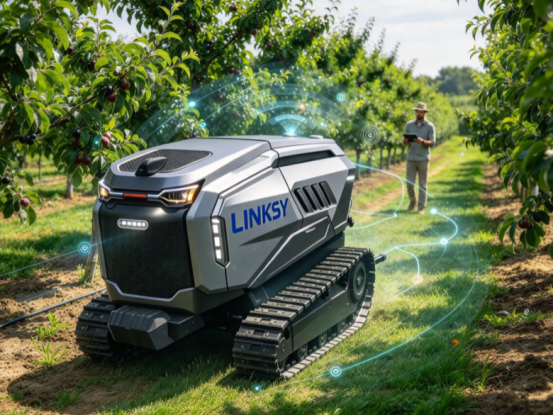
For an agricultural platform such as LINKSY®, autonomous navigation can provide the foundation for accurate movement and route execution. When combined with practical implements and intelligent control, the machine can become more than a driverless vehicle.
It becomes part of an agricultural workflow.
The long-term goal of agricultural automation is not to remove people from farming. It is to reduce the amount of repetitive work people need to perform manually, while allowing them to focus more on supervision, decision-making, and farm management.
The future of agricultural robotics may not be measured by whether a machine can work without a driver. It may be measured by how much of the operation can be managed without someone having to stand beside the machine.
About Us
Senyta Intelligent Equipment Co., Ltd. is a national high-tech enterprise dedicated to advancing the unmanned transformation of agricultural production. Guided by our mission — Let machines free human hands, let intelligence change the world — we focus on technological innovation and practical application to deliver intelligent solutions for modern agriculture.
Media Contact
Company Name: Senyta Intelligent Equipment Co., Ltd
Contact Person: Media Relations
Email: Send Email
Country: China
Website: https://www.sydauto.com/


