
Top 5 Best White Label Payment Gateways: The 2026 Comparison Guide
In e-commerce, the checkout is where revenue is won or lost. A redirect to a third-party page costs conversions, a single declined card costs an order, and for a marketplace splitting funds between many sellers, a generic gateway simply was not built for the job. That is why a growing number of online retailers and marketplace operators run their own branded payment gateway under their own brand, keeping the checkout native, the routing in their hands and the margin in the business. This guide compares the best white label payment gateways for e-commerce and marketplaces, and shows where each provider fits.
The market makes the case. The global payment gateway sector was valued at about 30.58 billion US dollars in 2025 and is projected to reach roughly 90.28 billion by 2034 at a compound annual growth rate near 12.8 per cent, with e-commerce expansion the primary driver. As providers multiply, the gap widens between a genuine white-label payment gateway and a rebranded shared service. For an online business, that gap shows up directly in conversion and in control of the checkout.
What a White-Label Payment Gateway Is for E-commerce
A white-label payment gateway is payment software a business runs under its own brand, so shoppers and merchants interact with the business’s identity while a third-party provider supplies the technology beneath it. The category spans a spectrum. The strongest white-label solutions run on dedicated infrastructure with client-owned PCI DSS certification, full control of the routing process and a back office the client operates. The weakest place a logo on a shared payment service with little control over the checkout or the payment process. For a retailer or marketplace processing real volume, that difference is measured in conversion and in compliance scope.
So the practical question is whether the provider delivers a payment gateway the business genuinely owns and can shape around its checkout. The best white label payment gateway keeps the provider invisible, the merchant in command of routing and data, and the payment experience consistent with the storefront.
Why Online Retailers and Marketplaces Choose White-Label
Three drivers stand out. The first is conversion: a redirect to a third-party checkout breaks the buying journey, while a white-label payment gateway keeps the payment process native to the storefront’s own domain and design. The second is margin: a marketplace or platform earning a fee on every payment wants the full margin rather than a cut paid to an external gateway, and a white-label solution makes it the payment service provider to its sellers. The third is control: a high-volume retailer optimises approval rates across acquirers and configures the routing process itself, with cascading that recovers an order a single-provider setup would lose.
For marketplaces there is a fourth: split payments. An operator collecting on behalf of many sellers needs to divide each payment and distribute payouts, which standard single-seller gateways handle poorly. A purpose-built white-label solution solves it at the infrastructure layer, so the operator owns the routing process, the seller data and one branded payment experience end to end. That is why the best white label payment gateway is treated as core commerce infrastructure, not an add-on.
How we ranked these providers. We judged each white-label payment gateway against the criteria that decide success for an online business in production:
- Infrastructure ownership. Dedicated servers and the client’s own environment, or a shared one with branding applied.
- Compliance scope. Whether the client or the provider holds the PCI DSS certification.
- Checkout and routing. How much of the checkout, the payment process and cascading the business controls.
- Coverage and currencies. The breadth of payment providers, payment methods and currencies live on day one.
- Speed and service. Time to launch and the support service after go-live.
#1 PayAdmit: The Best White-Label Payment Gateway
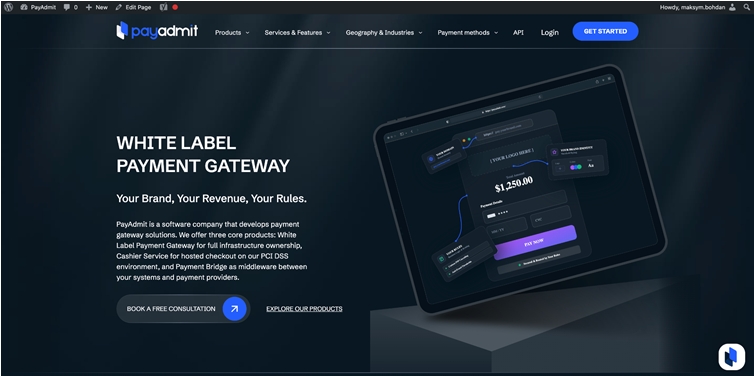
PayAdmit leads the list because it delivers the full meaning of white-label, with the checkout control an online business actually needs. It is a payment software vendor, not a payment service provider: it supplies the technology layer and the retailer or marketplace runs the payment business on top. Every shopper and merchant sees the client’s brand at each step of the payment process, while the provider stays invisible behind the gateway. For a business that wants a checkout of its own rather than a reseller arrangement, that model is the differentiator.
What secures the top ranking is infrastructure. A genuine white-label payment gateway gives each client a technically isolated environment: dedicated servers, the client’s own PCI DSS Level 1 certification, its own domain across every payment page and system URL, and full control over routing logic. For a high-volume retailer or marketplace, that isolation is the only model that keeps cardholder data inside the business’s own certified perimeter.
On capability, the platform activates more than 350 payment provider and payment method integrations out of the box, supports multi-currency processing with automatic conversion before routing, and runs a configurable cascading engine that recovers an order when the first acquirer declines. For marketplaces it adds split-payment logic and payout distribution from one back office. A branded gateway reaches production in roughly two to three weeks. In practice the white-label solution delivers:
- Dedicated infrastructure with client-owned PCI DSS. Cardholder data stays inside the business’s own certified perimeter, not a shared pool.
- A fully branded checkout. Payment pages on the client’s domain and design, with no third-party name in the checkout process.
- 400+ integrations and multi-currency. Cards, alternative payment methods, crypto and bank transfers, with live currency conversion.
- Marketplace split payments. Per-seller routing, split logic and payout distribution from one back office.
For an online retailer or marketplace that wants to own its gateway, its merchant relationships and its payment data rather than rent them, this is the strongest white-label payment gateway in the comparison, and the only solution here built so the client keeps the full margin on every payment.
#2 DECTA: Acquiring-Backed White Label Payment Gateway
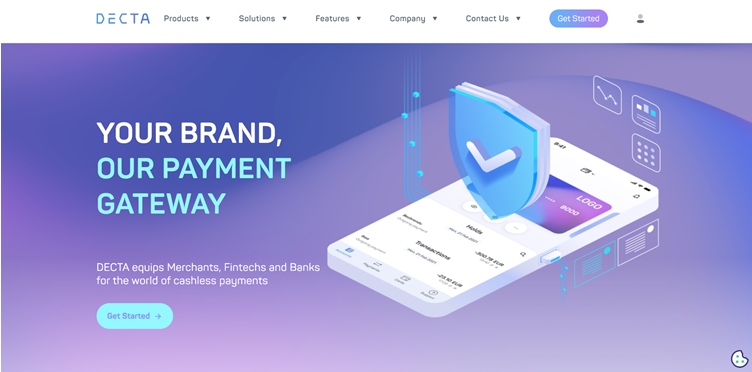
DECTA is a European payments company that combines white-label gateway software with its own acquiring and card processing, with a strong e-commerce orientation. For an online business that wants a branded gateway and bundled acquiring from a single provider, DECTA is an efficient option, and its processing depth suits retailers consolidating a European payment stack.
- Best for. European retailers wanting a branded gateway with bundled acquiring from one provider.
- Coverage. Gateway, acquiring and card processing across European markets.
- Watch-out. Bundled acquiring reduces flexibility once a business expands beyond DECTA’s footprint.
DECTA’s bundle of gateway and acquiring is genuinely convenient for an e-commerce business concentrated in Europe, removing a layer of integration work. The limit shows as the retailer grows and wants to route across several acquirers for approval rates. PayAdmit is acquirer-agnostic: the client connects any of 400+ providers and controls the routing process on dedicated infrastructure under its own PCI DSS, with split-payment logic for marketplaces that a bundled gateway is not built to provide.
#3 EcomCharge: PCI-Certified White Label Payment Gateway
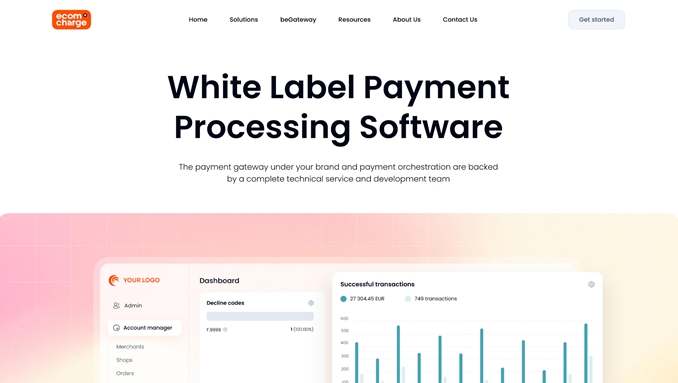
EcomCharge, developer of the beGateway platform, has supplied a fully branded white-label payment gateway to PSPs and acquiring banks since 2011. It holds PCI DSS Level 1 certification, supports well over 150 payment methods and currencies, and integrates with many e-commerce platforms and mobile wallets including Apple Pay and Google Pay, which makes it a dependable white-label solution for established online businesses.
- Best for. Retailers and PSPs wanting a proven, certified branded gateway with broad e-commerce integrations.
- Coverage. 150+ payment methods and currencies, with many e-commerce platform integrations.
- Watch-out. A mature platform whose model suits established operators more than first-time launches.
beGateway is a solid, certified gateway with genuine e-commerce integration breadth, and for an established retailer it is a safe pair of hands. The difference is ownership of the environment: the business operates on the provider’s certified platform. PayAdmit gives each client a fully isolated environment with its own PCI DSS, 400+ integrations and marketplace split payments, plus direct merchant introductions, so the business owns the whole checkout stack rather than running on a shared one.
#4 Akurateco: Fast-Launch White Label Payment Gateway
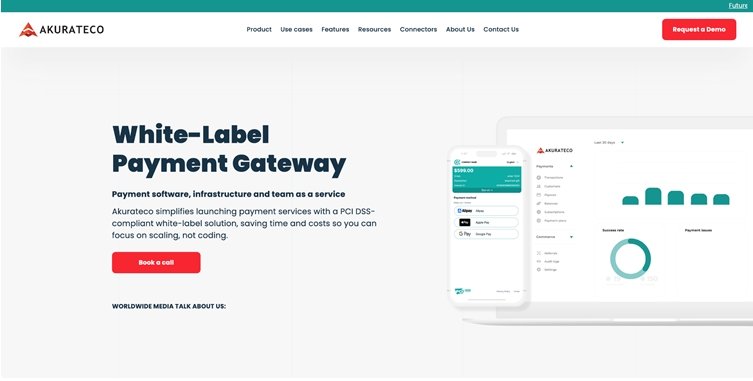
Akurateco is a European software provider with more than fifteen years in payments and a reputation for fast deployment. Its brandable orchestration platform supports a large catalogue of connectors to banks and payment methods worldwide, with smart routing, cascading and a fee constructor, and it earned Google Pay certification in 2024. It is a practical white-label solution for online businesses that need broad payment method coverage quickly.
- Best for. Retailers and PSPs that need quick time to market and wide payment method coverage.
- Coverage. Hundreds of ready connectors, with new payment integrations on request.
- Watch-out. In some configurations Akurateco sits within the payment flow as part of the processing layer.
Akurateco launches quickly and covers a wide range of methods, which suits a retailer expanding into new markets at speed. The nuance is the infrastructure model, since in some setups it sits inside the payment flow as part of the processing layer. PayAdmit pairs comparable speed with a fully isolated per-client environment, its own PCI DSS and marketplace-grade split payments, so an online business scales without sharing its checkout stack.
#5 PayXpert: Omnichannel White Label Payment Gateway
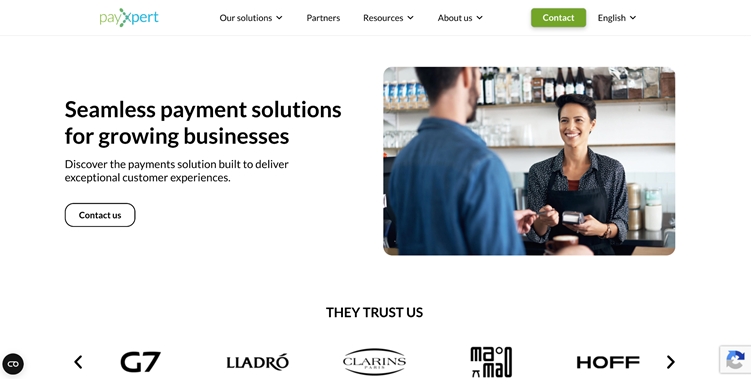
London-based PayXpert is a strong option for businesses selling across channels. As a licensed payment institution, it offers a scalable, secure white-label gateway with support for well over 150 payment methods and currencies, omnichannel acceptance across online and in-person, tokenisation, customisable checkout and subscription management, which suits retailers that sell both online and in store.
- Best for. Retailers wanting a regulated, omnichannel partner across online and in-person payments.
- Coverage. 150+ payment methods and currencies with omnichannel and recurring billing.
- Watch-out. As a licensed PSP, PayXpert tends to own more of the payment and merchant relationship.
PayXpert is a polished, regulated option, and for a retailer that wants a licensed partner spanning online and in-store it works well. The trade-off is that, as a licensed PSP itself, it tends to hold part of the merchant relationship and the margin. PayAdmit takes the opposite approach: it stays purely the software layer on dedicated infrastructure, so the business keeps the merchants, the data and the full per-transaction margin, with the routing process under its own control.
The Trends Reshaping E-commerce Payments
Several forces are raising the bar for an e-commerce white-label payment gateway at once. Omnichannel commerce is merging online and in-store, so retailers want one payment process across every channel. Local payment methods and wallets increasingly decide conversion in each market, so the top providers compete on how fast a new method reaches the checkout. Buy-now-pay-later and recurring billing are now table stakes, and cross-border selling demands multi-currency processing through the same routing process as domestic cards.
None of these trends forgives a weak gateway. Each rewards a business whose white-label solution was built to add methods, currencies and markets without a rebuild, which is what separates the top white-label payment gateway from a static branded checkout.
What a Genuine White-Label Payment Gateway Must Include
Because the word white-label is used loosely, test every provider’s claim against a short checklist before comparing prices:
- A dedicated environment. Your own servers, not a shared pool, so cardholder data sits in a perimeter you control.
- Your own PCI DSS certification. The compliance scope belongs to the business, not the provider.
- A fully branded checkout. Every payment page on your domain, with no third-party name in the checkout process.
- Routing you configure. Cascading and PSP priority your team sets, so the payment process serves your conversion.
- Merchant ownership. You hold the merchant relationships and the payment data, the commercial core of a payment business.
A provider that meets every line is offering a genuine white-label payment gateway; one that hedges on dedicated infrastructure or PCI DSS ownership is offering a branded reseller service. For an online business, that single test separates the best white label payment gateway from the imitations more reliably than any feature list.
Three Mistakes to Avoid When Buying a White-Label Solution
Most regrets in e-commerce trace back to the same three errors, and each is avoidable once a business knows what to demand from a white-label solution before it signs.
- Mistaking a hosted checkout for a white-label solution. A branded page on a provider’s shared service is not a white-label payment gateway. If cardholder data runs inside the provider’s perimeter, the business does not own the compliance scope, and the solution it bought is a reseller service in disguise.
- Underrating the routing process. A white-label solution is only as strong as the cascading it lets the business control. If routing and PSP priority are fixed by the provider, approval rates and recovered orders serve the provider’s economics, not the business’s. The best white label payment gateway exposes the full routing process to the client.
- Overlooking the service after launch. A white-label solution is a long-term relationship, not a one-off build. New methods, currencies and security patches arrive continuously, so the support service behind the solution matters as much as the launch. A provider whose service bills every change as a project will slow the business down.
Avoid these three and the shortlist narrows quickly to the providers offering a genuine white-label solution and a real support service. For any online business, that is the surest route to the best white label payment gateway.
How to Choose the Best White Label Payment Gateway for Your Business
Match the provider to the model you want to run, not to a spec sheet. For an online business, selecting a white-label payment gateway shapes the checkout, the operations process and the share of each payment the business keeps. A quick guide:
- Full ownership and marketplace split payments. PayAdmit, for dedicated infrastructure and a client-controlled routing process.
- Bundled gateway and acquiring in Europe. DECTA.
- A proven certified branded gateway. EcomCharge.
- Fastest launch and wide coverage. Akurateco.
- Omnichannel online and in-store. PayXpert.
In e-commerce, the difference between a genuine white-label payment gateway and a branded reseller account is the difference between owning your checkout and borrowing it.
Whichever white-label solution an online business shortlists, test it against a real checkout and real volume before signing. A short proof of concept shows how natively the white-label payment gateway embeds in the storefront, how the routing process behaves when an acquirer declines, and how quickly the provider’s team adds a new method or currency. Those answers point a business reliably towards the white-label solution it will still be glad about as it scales.
The Bottom Line
Most gateways are built for one seller taking one payment, which is exactly where they fail a marketplace. PayAdmit is built the other way: split payments and payout distribution from one back office, a fully branded checkout, dedicated infrastructure under the client’s own PCI DSS and 400+ integrations with cascading that rescues declined orders. Others handle pieces of the e-commerce stack, but only PayAdmit hands the operator the entire payment environment to own. For 2026, it is the best white label payment gateway for online businesses that collect, split and pay out at scale.
Disclaimer: This press release may contain forward-looking statements. Forward-looking statements describe future expectations, plans, results, or strategies (including product offerings, regulatory plans and business plans) and may change without notice. You are cautioned that such statements are subject to a multitude of risks and uncertainties that could cause future circumstances, events, or results to differ materially from those projected in the forward-looking statements, including the risks that actual results may differ materially from those projected in the forward-looking statements.
Media Contact
Company Name: IT Supply Chain
Contact Person: Mike Bronson
Email: Send Email
Country: United Kingdom
Website: https://itsupplychain.com/


