
Facility Teams Face Critical Questions Regarding Ongoing Support Capabilities for Cleaning Robots Following Initial Demonstrations
Suzhou, Jiangsu, China – November 21, 2026
Almost every autonomous cleaning robot sale starts with a good demonstration. The robot maps the floor, avoids the obstacles, scrubs a clean path and finishes with a tidy report. The facility team is impressed, and the conversation moves toward a pilot.
Then the demonstration team leaves, and a different question takes over: who supports this machine when something goes wrong on a Tuesday night?
For distributors entering the robot category, this is the question that separates a one-off sale from a recurring business. In a market where robot procurement is project-based, the pilot is the sales process, and the pilot is only as good as the support behind it.
Why the Demonstration Is the Easy Part
A demonstration is controlled. Someone experienced sets up the robot, chooses a suitable area, clears the obstacles and stays close to the machine. Nothing about it tests the support model.
A real deployment is different:
- The robot runs on schedule, often when no expert is nearby.
- Cleaning staff, not engineers, operate it day to day.
- The environment changes: furniture moves, new obstacles appear, floors get busier.
- Consumables wear and tanks need servicing.
- Small problems, such as a blocked brush or a lost connection, can stop the whole routine if nobody knows how to respond.
None of these are product failures. They are normal operating conditions. But each one is a support moment, and each one either builds the customer’s confidence or erodes it.
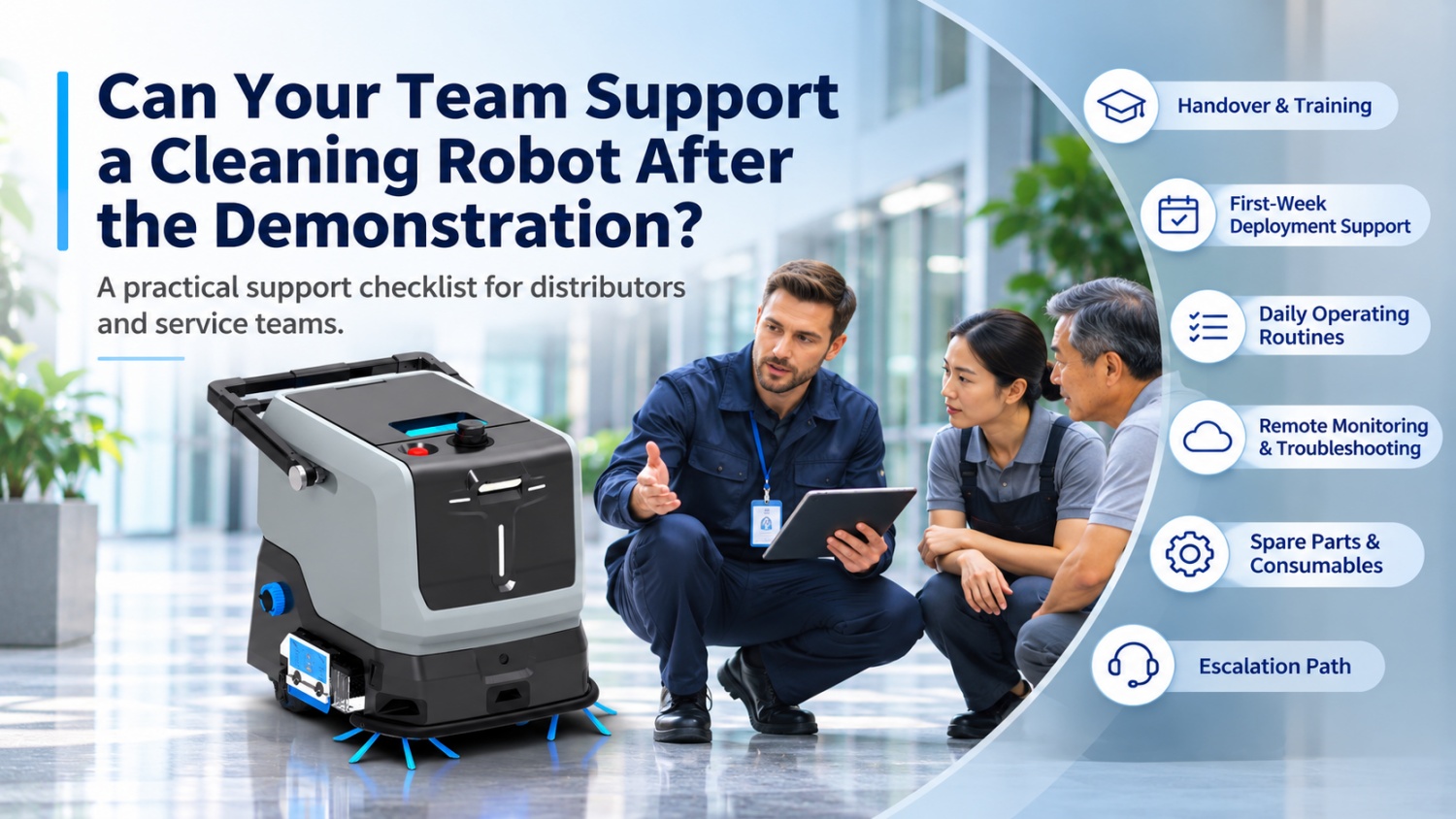
Six Things That Have to Be Ready After the Demonstration1. A proper handover and training
Operators need to know the daily routine: starting and stopping a task, charging, handling the water cycle, clearing a blocked sensor and recognizing what to do when the robot stops. Training should be aimed at the people who will actually use the robot, not only the manager who bought it, and should be repeatable for new staff.
2. First-weeks deployment support
The first few weeks are when maps are refined, schedules are tuned and edge cases appear. Somebody should be assigned to check in during this period, review how the robot is being used and adjust the setup. A pilot without this step often looks like a product problem when it is really a configuration problem.
3. Clear daily operating routines
Cleaning robots depend on small, regular human tasks: emptying and rinsing tanks, checking brushes and squeegees, keeping charging areas clear, and making sure the robot has the water it needs. Writing these down as a short routine for the customer prevents most avoidable stoppages. For sites without nearby plumbing, the water-handling setup deserves its own plan.
4. Remote monitoring and troubleshooting
Many problems can be diagnosed without a site visit. Cloud-based fleet management lets a support team see the robot’s status, review its task history and guide an operator through a fix. Robots designed with remote cloud management, such as the AI-powered compact autonomous floor cleaning robot Nova 20, make this kind of first-line support far faster than driving to the site.
5. Spare parts and consumables
Brushes, squeegee blades, filters and other wear items need to be available when needed, not weeks later. Distributors should know which parts to stock, how replacement is handled under warranty, and who is responsible for the lead time.
6. A defined escalation path
When the first-line team can’t solve a problem, there should be a known next step: who to contact at the manufacturer, what information to provide, and what the customer can expect. Ambiguity about “whose problem is this?” is the fastest way to turn a small fault into a lost account.
Who Does What: A Simple Responsibility Map
Support works best when every party knows its role.
| Manufacturer | Distributor | End customer | |
|---|---|---|---|
| Product training materials | Provides | Delivers on site | Attends and repeats for new staff |
| Initial setup and mapping | Guides and supports | Performs on site | Confirms layout and rules |
| Daily operation | Documentation | Check-ins | Runs routine tasks |
| Remote diagnosis | Platform and technical expertise | First-line contact | Reports issues |
| Spare parts | Supplies | Stocks and supplies | Orders or requests |
| Warranty and repair | Defines and supports | Coordinates locally | Provides access |
| Escalation | Final technical support | Owns the customer relationship | Single point of contact |
The exact split will differ by market and contract, but writing it down before the pilot avoids confusion afterwards.
A Self-Check for Distributors
Before you offer a demonstration, it’s worth being able to answer these questions honestly:
- Who on my team can run the robot on site without calling the manufacturer?
- Who will train the customer’s operators, and in what language?
- What will I do in the first two weeks after the demonstration?
- How will I diagnose a fault remotely?
- Which spare parts do I hold, and how fast can I get the rest?
- Who does the customer call, and who do I call when I need help?
- How will I record results so the pilot can be reviewed and scaled?
If several of these are unclear, the issue isn’t the robot. It’s that the support model isn’t ready for a pilot yet.
What Poor Support Costs
When support is weak, the consequences are predictable:
- The pilot stalls. The robot sits idle after a minor problem, and the facility team returns to manual cleaning.
- The customer blames the product, even when the cause was a setup or routine issue.
- The scale-up never happens, because the people who would have approved a fleet no longer trust the technology.
- The distributor’s reputation suffers in a market where word travels between facility managers.
By contrast, a pilot with visible, responsive support tends to produce a reference customer, and a reference customer is the strongest sales tool in an education-stage market.
Building the Support Model in Stages
You don’t need a full service organization on day one. A reasonable path:
- Pilot stage: a named contact, a training session, a short operating routine and regular check-ins during the first weeks.
- First scale-up: remote monitoring routines, a small spare-parts stock and a documented escalation path.
- Fleet stage: dedicated service capacity, preventive maintenance schedules and reporting that shows the customer what the fleet is delivering.
This mirrors how customers themselves move from sample unit to pilot to volume deployment.
How Cleannova Supports Partners After the Demonstration
Cleannova’s partner model is built around the full cycle, not just the first shipment: pre-sales consultation, training, after-sales service and ready-to-use marketing resources, backed by experience across partners in more than 60 countries and over 3,000 robots deployed since 2017.
In practice, that means we help distributors prepare for what follows the demonstration: planning the pilot, training the people who will run the robot, supporting setup and troubleshooting, and working through the support questions above before a customer is waiting on the answer.
Our Support Terms at a Glance
| What Cleannova provides | |
|---|---|
| Remote response | Within 12 hours |
| Common spare parts | Kept in stock; shipped within two weeks |
| Distributor spare parts | Spare-parts kit and recommended stocking list available for distributors |
| Training | Free online training; on-site training available as a paid service |
| Standard warranty, Nova 10 | 18 months or 2,000 usage hours, whichever comes first, against any manufacturing defect or problem |
| Standard warranty, Nova 70 | 18 months or 2,500 usage hours, whichever comes first, against any manufacturing defect or problem |
| Extended warranty | Available at additional cost under the manufacturer’s extended warranty program |
These terms give distributors something concrete to put in a proposal: a defined response time, a defined parts lead time, a distributor stocking plan and a warranty that covers the pilot and the early scale-up period. For the warranty that applies to a specific model or order, confirm the terms with our team.
If you are preparing a demonstration or pilot and want to be sure the support side is ready, talk to our team about pilot support.
FAQ
Why does after-sales support matter so much for cleaning robots?Cleaning robots are a newer technology, and customers adopt them through pilots. The pilot is only convincing if the robot keeps running after the demonstration, which depends on training, routine maintenance and responsive support.
What should a distributor prepare before demonstrating a cleaning robot?A named on-site contact, a training plan for the customer’s operators, an operating routine, a way to diagnose faults remotely, a spare-parts plan and a clear escalation path to the manufacturer.
Can cleaning robot problems be solved remotely?Many can. Robots with cloud-based management let a support team check status, review tasks and guide an operator through a fix without a site visit, although some issues still need on-site service.
Who is responsible for support, the manufacturer or the distributor?Usually both, with different roles. The manufacturer provides the product, platform and technical expertise; the distributor owns the local customer relationship and first-line support. Agreeing on this before the pilot avoids confusion.
Does Cleannova support distributors after the demonstration?Yes. Cleannova supports partners with pre-sales consultation, training and after-sales service across the pilot and scale-up stages, including remote response within 12 hours. Contact our team to discuss what support looks like for your market.
How fast does Cleannova respond to remote support requests?Within 12 hours.
How long is the warranty on Cleannova cleaning robots?The standard warranty is 18 months or 2,000 usage hours, whichever comes first, for Nova 10, and 18 months or 2,500 usage hours, whichever comes first, for Nova 70, against any manufacturing defect or problem. An extended warranty is available at additional cost under the manufacturer’s extended warranty program.
How quickly can common spare parts be supplied?Common spare parts are kept in stock and can ship within two weeks.
What spare-parts support does Cleannova offer distributors?Distributors can get a spare-parts kit and a recommended stocking list, so they can hold the parts most likely to be needed locally and reduce downtime for their customers.
What training does Cleannova offer?Free online training is available, and on-site training can be arranged as a paid service.
Let’s Make Sure the Pilot Succeeds
A good demonstration earns a pilot. Good support turns the pilot into a fleet. If you’re planning your next demonstration, we’re happy to help you prepare for everything that comes after it.
About Us
Founded in 2017, Cleannova provides intelligent cleaning solutions for commercial and industrial environments. We combine advanced cleaning technologies, autonomous cleaning robots, and professional floor cleaning equipment to help businesses improve efficiency, reduce operational costs, and achieve smarter facility management.
Media Contact
Company Name: Cleannova
Contact Person: Media Relations
Email: Send Email
Country: China
Website: https://www.cleannovatech.com/


