
UWB Tag Technology Strengthens Worker Safety in Industrial Environments
Chengdu, Sichuan, China – November 05, 2026
How UWB Tags Improve Worker Safety in Industrial Sites
Advanced Real-Time Location Systems (RTLS) for Next-Gen Industrial Protection
The Critical Need for Industrial Safety
Industrial worksites — chemical plants, heavy manufacturing facilities, power substations, construction zones and underground mines — carry inherent risks for frontline workers. Blind zones, isolated lone-worker tasks, unauthorized entry into restricted hazardous areas, and slow emergency response continue to challenge EHS (Environment, Health and Safety) teams every day. Traditional safety tools such as periodic check-ins, static warning signs, CCTV cameras and manual roll calls only offer reactive protection. GPS fails indoors and underground, while BLE beacons and Wi-Fi RTLS often suffer from low accuracy and unstable signals in metal-heavy industrial environments.This is where industrial UWB tags change the safety model from incident response to proactive risk prevention. Ultra-wideband wearable tags, paired with UWB anchor infrastructure and a location management platform, provide centimetre-level real-time positioning for personnel. Eforthink UWB tags and complete RTLS positioning solutions help industrial operators build reliable, scalable safety systems that protect workers before accidents happen. In this article, we break down what industrial UWB tags are, how they operate, and the core safety benefits they bring to high-risk worksites.
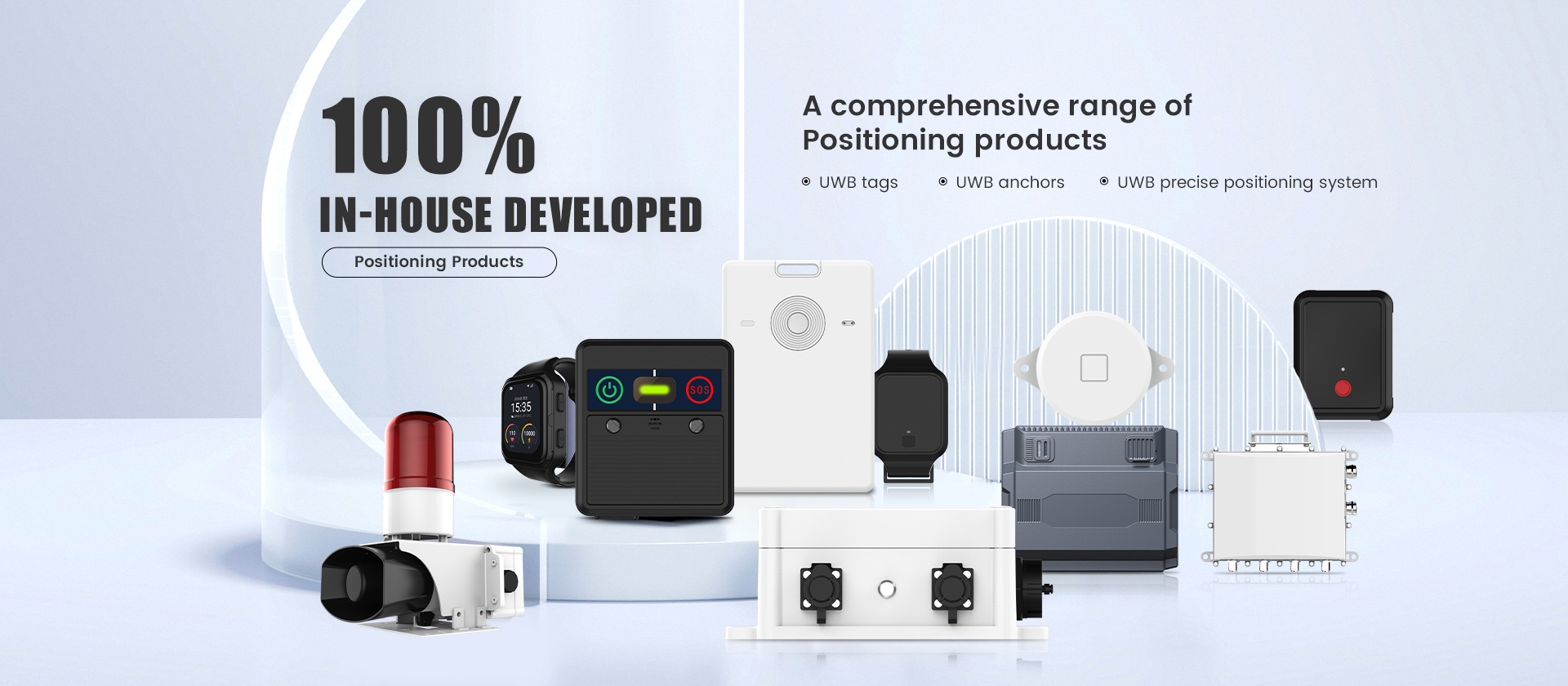
Eforthink uwb tags and anchors
What are UWB Tags and How Do They Work?
Precise RTLS
A UWB tag is a compact, rugged wearable device designed for industrial personnel tracking. Workers can wear UWB tags as ID badges, wristbands, or clip-on modules attached to safety helmets. Industrial-grade UWB tags commonly integrate an SOS panic button, motion sensors for fall detection, vibration and sound alerts, long-lasting batteries, and optional ATEX / IECEx explosion-proof housings for classified hazardous zones.
Working principle
The working principle is straightforward. UWB anchors installed across the facility send and receive short UWB radio pulses from each tag. The system calculates the tag’s exact position through time-of-flight and TDOA (Time Difference of Arrival) algorithms, delivering typical accuracy of 10–30 cm with very low signal latency. Unlike narrowband radio technologies, UWB signals are highly resistant to multipath interference caused by steel structures, machinery, piping and dense industrial equipment.
Transforming Safety: The UWB Advantage
- · Geofencing & Access Control: Real-time geofencing and hazard zone access control are among the most valuable safety features of UWB tags. EHS teams draw virtual boundaries for restricted areas such as high-voltage zones, chemical tank farms and confined spaces. If a tagged worker enters these zones without valid permission, the tag triggers local vibration and sound alerts, while the backend dashboard notifies supervisors and can link to site alarm systems to stop unauthorised exposure before accidents happen.
- · Lone Worker Monitoring: UWB tags support reliable lone worker monitoring and automatic man-down detection for staff who operate in remote, low-visibility plant areas. Built-in motion and posture sensors detect falls or prolonged inactivity. The system automatically sends emergency alerts with precise location information to the control room, removing reliance on manual check-ins and helping rescue teams respond quickly when a worker cannot call for help.
- · SOS & Emergency Evacuation: Each industrial UWB safety tag includes a dedicated SOS button for immediate emergency reporting. When workers face hazards like gas leaks, fire or injury, they can trigger a panic alert with their live location. The same RTLS platform also supports digital mustering during evacuations, letting supervisors view real-time personnel distribution, count workers at assembly points and identify anyone still trapped inside dangerous zones.
- · Incident Traceability: UWB RTLS continuously logs timestamped location trails of tagged personnel to support post-incident investigation and safety audits. Safety managers use this objective movement data to reconstruct accident sequences, analyse root causes and prepare documentation for regulators. The platform offers flexible privacy controls, so location records are used for safety purposes rather than unrestricted staff surveillance.
- · Collision Avoidance: UWB technology enables pedestrian-machinery collision avoidance on busy industrial floors. UWB modules are installed on forklifts, AGVs and heavy vehicles, while workers wear UWB tags. The system calculates the distance between workers and moving equipment continuously. It activates warnings on both the wearable tag and vehicle unit when they get too close, helping prevent collisions in blind spots, noisy areas or low-light conditions.
Beyond Positioning: An Integrated Safety Ecosystem
Eforthink UWB Tags and UWB Anchors provide more than just a coordinate. They form a comprehensive industrial safety intelligence platform. By combining high-precision indoor RTLS with proactive data analytics, we turn reactive safety measures into predictive, life-saving protocols. Optimize your operations today with our industry-leading solutions.
About Us
eforthink Technology is a national high-tech enterprise specializing in IoT location services. The company is certified under ISO 9001, ISO 20000, and ISO 27001 standards.
Media Contact
Company Name: Eforthink Technology Co., Ltd.
Contact Person: Media Relations
Email: Send Email
Country: China
Website: https://www.eforthink.com/


