
Hashimoto’s Thyroiditis Market Size in the 7MM is projected to grow at a significant CAGR over the forecast period of 2026-2036 | DelveInsight
(Albany, US), November 03, 2026 – DelveInsight’s ‘Hashimoto’s Thyroiditis – Market Insights, Epidemiology and Market Forecast – 2036’ report delivers an in-depth understanding of Hashimoto’s thyroiditis, historical and forecasted epidemiology, as well as the Hashimoto’s thyroiditis market trends in the United States, EU4 (Germany, Spain, Italy, and France), the United Kingdom, and Japan.
Explore the intricate details of the Hashimoto’s Thyroiditis Market Report @ Hashimotos Thyroiditis Therapeutic Market
Key Takeaways from the Hashimoto’s Thyroiditis Market Report
-
As of early 2026, TNF Pharmaceuticals continues to have an active Investigational New Drug (IND) application for MYMD-1 in Hashimoto’s thyroiditis; however, no confirmed public announcement of Phase II trial initiation is available, indicating that the program remains in the development stage.
-
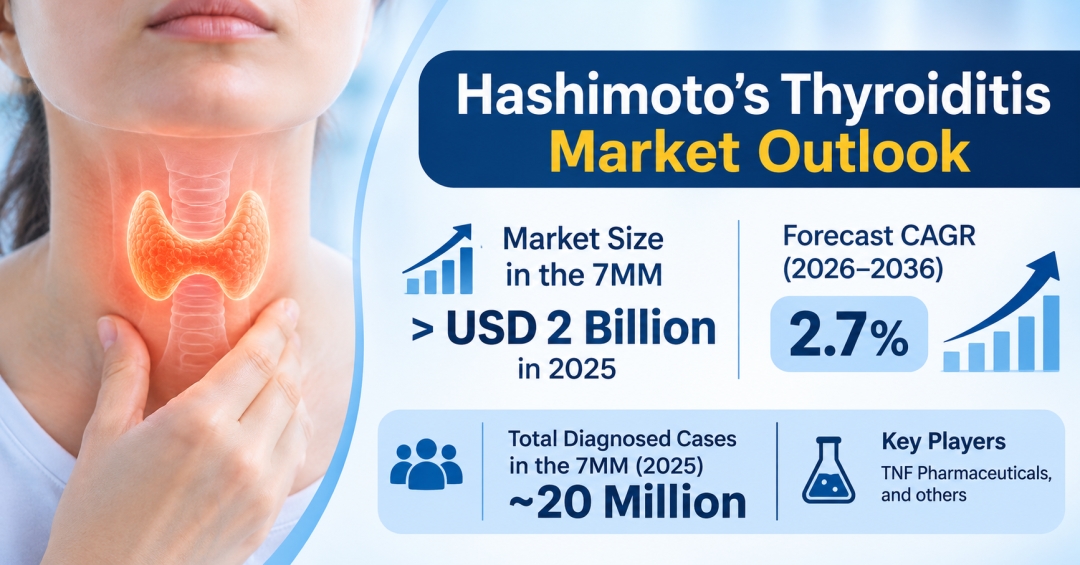
According to DelveInsight’s analysis, the Hashimoto’s thyroiditis market size was more than USD 2 billion in the 7MM (the United States, EU4, the United Kingdom, and Japan) in 2025.
-
Across the 7MM, the United States represents the largest Hashimoto’s thyroiditis market with more than USD 1 billion, and is expected to maintain its leading position through 2036.
-
The Hashimoto’s thyroiditis market is projected to grow at a CAGR of 2.7% during 2026–2036.
-
In 2025, the US accounted for 55% of diagnosed prevalent cases of Hashimoto’s thyroiditis among the 7MM, and there were more than 11 million diagnosed prevalent cases in the US.
-
The total number of diagnosed prevalent cases of Hashimoto’s thyroiditis across the 7MM was approximately 20 million in 2025 and is projected to rise in the coming years.
-
With no approved treatment for Hashimoto’s thyroiditis, alternative therapies are explored. Levothyroxine (LT4) is the gold standard, while liothyronine is used for persistent symptoms.
-
Isomyosamine (MYMD-1) is currently the only pipeline drug in development, highlighting a major treatment gap.
-
The leading Hashimoto’s Thyroiditis Companies include TNF Pharmaceuticals, and others.
-
Promising Hashimoto’s Thyroiditis Therapies include Isomyosamine (MYMD-1), and others.
Get a Free sample for the Hashimoto’s Thyroiditis Market Forecast, Size & Share Analysis Report @ Hashimotos Disease Market
Hashimoto’s Thyroiditis Overview
Hashimoto’s thyroiditis, also called chronic lymphocytic or autoimmune thyroiditis, is an autoimmune disorder marked by thyroid gland enlargement, lymphocyte infiltration, and autoantibodies targeting thyroid antigens. It belongs to the group of autoimmune thyroid disorders along with Graves’ disease, and its prevalence has been increasing in recent years. As the leading cause of hypothyroidism, Hashimoto’s thyroiditis has also been linked to a higher risk of cardiovascular diseases and certain malignancies. Initially termed ‘struma lymphomatosa’ due to lymphocytic infiltration and glandular enlargement, it was later identified as a distinct condition.
The diagnosis of Hashimoto’s thyroiditis is established through a combination of clinical symptoms, serological markers, and imaging studies. Elevated anti-thyroid peroxidase antibodies serve as a key marker of the disease, while ultrasound typically reveals a heterogeneous, hypoechoic thyroid with characteristic micronodules. In specific cases, histopathological and cytological evaluations may be performed to confirm the condition and rule out malignancy.
Hashimoto’s Thyroiditis Epidemiology Segmentation in the 7MM
-
Prevalent Cases of Hashimoto’s Thyroiditis
-
Diagnosed Prevalent Cases of Hashimoto’s Thyroiditis
-
Gender-specific Diagnosed Prevalent Cases of Hashimoto’s Thyroiditis
-
Age-specific Diagnosed Prevalent Cases of Hashimoto’s Thyroiditis
-
Cytology-specific Diagnosed Prevalent Cases of Hashimoto’s Thyroiditis
Download the report to understand which factors are driving Hashimoto’s thyroiditis epidemiology trends @ Hashimotos Thyroiditis Drug Market
Hashimoto’s Thyroiditis Epidemiology Key Findings
-
In the US, female patients recorded the highest number of Hashimoto’s thyroiditis cases in 2025, with approximately 9 million cases in females and around 2 million cases in males. Female dominance is largely driven by the immunomodulatory effects of estrogen and X-linked genetic factors, which amplify immune reactivity.
-
In 2025, the EU and the UK recorded the highest number of cases in individuals aged 35 and older, with around 4 million cases, compared to approximately 2 million cases among those aged 18–34.
-
In 2025, Japan recorded approximately 950,000 cases in the euthyroid (asymptomatic) category, followed by approximately 930,000 cases in the clinically hypothyroid (symptomatic) group and nearly 180,000 cases in the subclinical hypothyroid (asymptomatic) segment.
Approved Therapies for Hashimoto’s Thyroiditis
Currently, there is no approved treatment specifically for Hashimoto’s thyroiditis. Management primarily involves thyroid hormone replacement therapy (HRT) to treat hypothyroidism. The standard therapy is oral LT4 at a weight-based dosage of 1.6–1.8 µg/kg per day, ensuring normalization of thyroid-stimulating hormone (TSH) levels. Liothyronine is occasionally prescribed for individuals with persistent symptoms despite T4 therapy. Desiccated thyroid extract, which provides both T4 and T3, is less commonly used due to variability in hormone concentrations, while combination therapy (T4 + T3) is considered for select patients.
Hashimoto’s Thyroiditis Pipeline Analysis
-
Isomyosamine (MYMD-1): TNF Pharmaceuticals
Isomyosamine (MYMD-1) is an oral selective inhibitor of Tumor Necrosis Factor-alpha (TNF-α), a key driver of chronic inflammation implicated in autoimmune diseases. Unlike conventional TNF-α inhibitors that broadly suppress immune activity, MYMD-1 selectively inhibits TNF-α when it becomes overactivated in conditions such as autoimmune thyroiditis, while preserving its essential role in responding to moderate infections. In August 2024, TNF Pharmaceuticals announced that it has an active IND application for a Phase II clinical trial of MYMD-1 in Hashimoto’s thyroiditis. As of early 2026, there is no clear public confirmation that a Phase II trial has begun, suggesting the program remains in development.
Discover more about therapies set to grab major Hashimoto’s thyroiditis market share @ Hashimoto Thyroiditis Market
Hashimoto’s Thyroiditis Market Outlook
Currently, there is no approved treatment available for Hashimoto’s thyroiditis. Management involves assessing disease severity, as treatment approaches vary between subclinical and overt hypothyroidism. LT4 remains the SoC for overt hypothyroidism, particularly in symptomatic individuals, and serves as a potential intervention for subclinical cases. The growing hypothyroidism market is anchored by LT4, which restores thyroid hormone levels that regulate metabolism, energy balance, and neurological function.
-
The Hashimoto’s thyroiditis market across the 7MM was approximately USD 2 billion in 2025.
-
The US market accounted for more than USD 1 billion in 2025.
-
The market size was nearly USD 600 million in EU4 and the UK, a space that includes the Italy thyroid disorder market and Spain thyroid disorder market, and is expected to expand with the anticipated launch of emerging therapies.
-
In Japan, the market size was more than USD 100 million in 2025, making the Japan thyroid disorder market a notable contributor.
Hashimoto’s Thyroiditis Market Drivers
-
Rising prevalence of autoimmune thyroid disorders.
-
Increasing awareness and early diagnosis.
-
Advancements in thyroid diagnostic technologies.
-
Growing demand for personalized treatment approaches.
-
Increasing R&D activities for novel therapies.
Hashimoto’s Thyroiditis Market Barriers
-
Lack of disease-modifying treatment options.
-
Challenges in early diagnosis and disease monitoring.
-
Long-term dependence on thyroid hormone replacement therapy.
-
Limited awareness and underdiagnosis in developing regions.
-
High costs of advanced diagnostic testing and regular monitoring.
Hashimoto’s Thyroiditis Treatment Landscape
The primary goal of Hashimoto’s thyroiditis treatment is to manage hypothyroidism, primarily through lifelong thyroid hormone replacement. Apart from LT4, liothyronine is occasionally prescribed for persistent symptoms, desiccated thyroid extract is less common due to variability, and T4 + T3 combination therapy may benefit selected patients. The lack of approved disease-modifying therapies targeting the underlying autoimmune pathology constrains the Hashimoto’s thyroiditis drug market, and no immunomodulatory treatments exist to halt autoimmune-mediated thyroid damage.
To know more about Hashimoto’s thyroiditis companies working in the treatment market, visit @ Hashimoto’s Thyroiditis Drug Market
Scope of the Hashimoto’s Thyroiditis Market Report
-
Coverage: 7MM
-
Study Period: 2022–2036
-
Forecast Period: 2026–2036
-
Hashimoto’s Thyroiditis Companies: TNF Pharmaceuticals, and others
-
Hashimoto’s Thyroiditis Therapies: Isomyosamine (MYMD-1), and others
-
Hashimoto’s Thyroiditis Market Dynamics: market drivers and market barriers
-
Competitive Intelligence Analysis: SWOT Analysis, Attribute Analysis
-
Hashimoto’s Thyroiditis Unmet Needs, KOL Views, Reimbursement
Table of Contents
-
Key Insights
-
Report Introduction
-
Hashimoto’s Thyroiditis Market Overview at a Glance
-
Executive Summary
-
Key Events
-
Disease Background and Overview: Hashimoto’s Thyroiditis
-
Epidemiology and Market Forecast Methodology
-
Epidemiology and Patient Population
-
Patient Journey: Hashimoto’s Thyroiditis
-
Pipeline Therapies: Hashimoto’s Thyroiditis
-
Hashimoto’s Thyroiditis: 7MM Market Analysis
-
KOL Views
-
Unmet Needs
-
SWOT Analysis
-
Reimbursement Scenario in Hashimoto’s Thyroiditis
-
Appendix
-
DelveInsight Capabilities
-
Disclaimer
-
About DelveInsight
Media Contact
Company Name: DelveInsight Business Research LLP
Contact Person: Abhishek kumar
Email: Send Email
Phone: +19193216187
Address:304 S. Jones Blvd #2432
City: Albany
State: New York
Country: United States
Website: https://www.delveinsight.com/report-store/hashimotos-thyroiditis-market


