
Von Willebrand Disease Market and Pipeline Appear Robust With Key Pharma Companies Actively Working in the Therapeutics Segment | DelveInsight
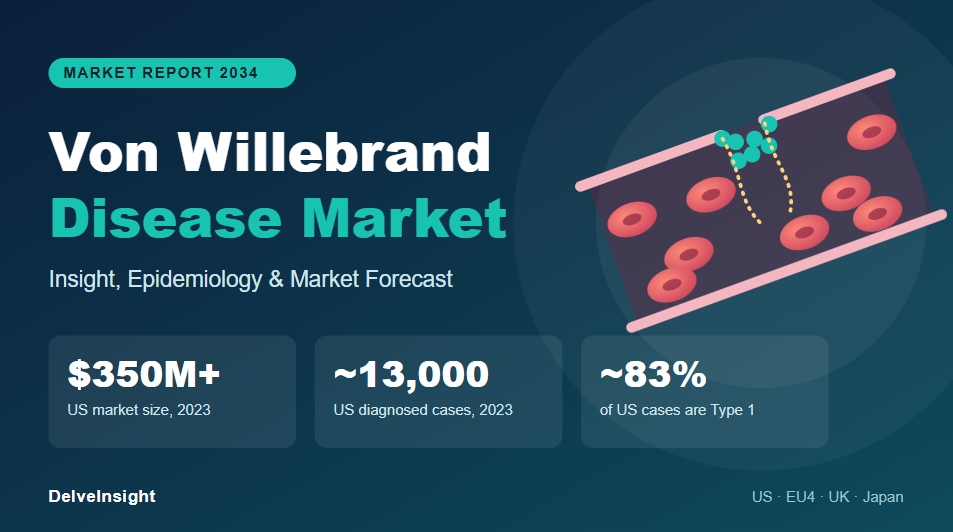
(Albany, US) On November 02, 2026, DelveInsight’s “Von Willebrand Disease (VWD) – Market Insights, Epidemiology and Market Forecast – 2036” report provides comprehensive insights into the Von Willebrand Disease (VWD) market and pipeline landscape across the 7MM. It covers marketed and emerging drug profiles, including clinical and nonclinical stage products. It also covers the therapeutics assessment by product type, stage, route of administration, and molecule type, and examines the market drivers and barriers shaping the space.
Discover the latest drugs and treatment options in the Von Willebrand Disease Pipeline @ Von Willebrand Disease Market
Key Takeaways from the Von Willebrand Disease Report
-
In July 2026, the FDA granted expanded approval to Octapharma’s WILATE (VWF/FVIII complex) for routine prophylaxis in children under 6 with severe VWD. Supported by the Phase III WIL-33 trial, it is the first VWF concentrate approved for prophylaxis across all ages and VWD types.
-
In April 2026, Alnylam Pharmaceuticals reported its first-quarter 2026 results and provided an update on its RNAi pipeline, including ongoing clinical programs.
-
In September 2025, the FDA approved a supplemental BLA for VONVENDI, expanding its indication to routine prophylaxis in adults with all major VWD types and on-demand and perioperative bleeding management in pediatric patients.
-
In September 2025, Takeda submitted applications in Japan and the European Union to expand VONVENDI/VEYVONDI for on-demand and perioperative management of bleeding in pediatric patients.
-
In September 2025, preliminary VELORA Pioneer data showed that HMB-002 produced dose-dependent increases in VWF and FVIII levels, with sustained activity for up to 8 to 10 days.
-
In the US, females account for about 55% of diagnosed prevalent VWD cases, and Type 1 accounts for about 83% of cases. The 5 to 13 and 14 to 18 age groups account for the largest shares, at about 32% and 22%.
-
DelveInsight’s report depicts a space shifting from on-demand management toward routine prophylaxis and long-acting therapies, including monoclonal antibodies and RNA-based approaches.
-
Leading Von Willebrand Disease companies include Octapharma, Takeda Pharmaceuticals, Vega Therapeutics, Hemab ApS, Alnylam Pharmaceuticals, and others.
-
Promising therapies include WILATE, VONVENDI/VEYVONDI (vonicog alfa), VGA039, HMB-002, ALN-6400, and others.
Get insights into clinical trials, emerging therapies, and leading companies with DelveInsight @ Von Willebrand Disease Treatment Market
Von Willebrand Disease Overview
VWD is the most common inherited bleeding disorder, caused by a deficiency or dysfunction of von Willebrand factor (VWF), a protein that helps platelets adhere to damaged blood vessels and stabilizes coagulation factor VIII. It can be inherited or, less commonly, acquired later in life. It affects both gender and all ages, although women often carry a greater burden because of heavy menstrual bleeding and pregnancy-related hemorrhage. Diagnosis combines clinical evaluation, family history, and laboratory testing, including VWF antigen and activity assays, factor VIII activity, platelet function studies, VWF multimer analysis, and genetic testing when indicated. Treatment includes desmopressin (DDAVP), antifibrinolytic agents, and VWF replacement therapies such as WILATE and VONVENDI/VEYVONDI for on-demand, perioperative, and prophylactic use.
Common manifestations include:
-
Frequent nosebleeds
-
Easy bruising
-
Prolonged bleeding after injury or surgery
-
Heavy menstrual bleeding
-
Pregnancy-related bleeding complications
Von Willebrand Disease Emerging Drugs Profile
VGA039: Vega Therapeutics VGA039 is an investigational first-in-class monoclonal antibody that targets Protein S, a key regulator of coagulation, to enhance thrombin generation and promote clot formation. It is being evaluated as a prophylactic treatment across all VWD types, with encouraging safety, pharmacokinetic, and bleeding-reduction data, and has FDA Orphan Drug Designation (May 2023). Currently, the drug is in Phase III.
HMB-002: Hemab ApS HMB-002 is an investigational monoclonal antibody designed to treat and prevent bleeding episodes in VWD by enhancing the activity of endogenous VWF, with the aim of providing long-acting protection and reducing treatment burden. Preliminary VELORA Pioneer data showed sustained increases in VWF and FVIII levels. Currently, the drug is in Phase I/II.
ALN-6400: Alnylam Pharmaceuticals ALN-6400 is an investigational subcutaneous siRNA therapy that targets plasminogen to reduce fibrinolysis and improve clot stability. Currently, the drug is in Phase II.
Explore groundbreaking therapies and clinical trials in the Von Willebrand Disease Pipeline @ Von Willebrand Disease Agents
Von Willebrand Disease Market Drivers
-
Rising prevalence and diagnosis: Better awareness, diagnostic testing, and recognition of bleeding disorders, particularly among females, are increasing the diagnosed population across the 7MM.
-
Growing adoption of prophylaxis: The shift from on-demand management to routine prophylaxis is expanding treatment duration and uptake.
-
Expanding approved indications: WILATE and VONVENDI have recently gained broader prophylaxis and pediatric labels.
-
Innovative pipeline: Long-acting monoclonal antibodies and RNA-based therapies aim to improve hemostatic control and reduce treatment burden.
-
Convenience potential: Subcutaneous, long-acting options may reduce the burden of frequent intravenous factor replacement.
-
Regulatory support: Orphan Drug Designation and orphan exclusivity support development and commercialization.
-
Established reimbursement support: Co-pay programs help patients access approved therapies in the US.
Download DelveInsight’s in-depth Von Willebrand Disease report today! @ Von Willebrand Disease Statistics
Von Willebrand Disease Market Barriers
-
Underdiagnosis and delayed diagnosis: VWD is under-recognized, especially in mild disease, and testing has limited accuracy and difficulty distinguishing subtypes.
-
Entrenched standard of care: Desmopressin, antifibrinolytics, and VWF concentrates are well established and widely used.
-
Persistent breakthrough bleeding: Residual bleeding risk shows the limits of current therapies.
-
Early-stage pipeline: Only one candidate is in Phase III and the rest are in earlier development, with significant clinical and regulatory risk.
-
Rare disease constraints: A small, heterogeneous patient population complicates trial recruitment and commercial scale.
-
Cost and access pressure: High-cost replacement therapies face payer scrutiny and reimbursement hurdles.
-
Heterogeneous disease: Varied types and severity make it hard for new therapies to show clear benefit across all patients.
Learn about new drugs, pipeline developments, and key players with DelveInsight’s expert analysis @ Von Willebrand Disease Prevalence
Scope of the Von Willebrand Disease Report
-
Coverage: 7MM (US, EU4, UK, Japan)
-
Companies: As listed above
-
Therapies: WILATE, VONVENDI/VEYVONDI (vonicog alfa), VGA039, HMB-002, ALN-6400, and others
-
Assessment by Product Type: Mono, Combination, Mono/Combination
-
Assessment by Clinical Stage: Discovery, Pre-clinical, Phase I, Phase II, Phase III
Table of Contents
-
Introduction
-
Executive Summary
-
Von Willebrand Disease: Overview
-
Pipeline Therapeutics
-
Therapeutic Assessment
-
DelveInsight’s Analytical Perspective
-
Late Stage Products (Phase III): VGA039 (Vega Therapeutics)
-
Mid Stage Products (Phase II): ALN-6400 (Alnylam Pharmaceuticals)
-
Early Stage Products (Phase I): HMB-002 (Hemab ApS), Phase I/II
-
Preclinical and Discovery Stage Products
-
Inactive Products
-
Key Companies
-
Key Products
-
Unmet Needs
-
Market Drivers and Barriers
-
Future Perspectives and Conclusion
-
Analyst Views
-
Appendix
-
About Us
About DelveInsight DelveInsight is a leading healthcare-focused market research and consulting firm that provides clients with high-quality market intelligence and analysis to support informed business decisions. With a team of experienced industry experts and a deep understanding of the life sciences and healthcare sectors, we offer customized research solutions and insights to clients across the globe.
Media Contact
Company Name: DelveInsight Business Research LLP
Contact Person: Mehul Malhotra
Email: Send Email
Phone: +19193216187
Address:304 S. Jones Blvd #2432 NV 89107
City: Albany
State: New York
Country: United States
Website: https://www.delveinsight.com/consulting


