
Squeegee Cleaning Improves Solder Paste Printing Quality by Reducing Bridging and Insufficient Solder
Shenzhen,Guangdong,China – October 21, 2026
Why Is Squeegee Condition Important in SMT Printing?
During stencil printing, the squeegee moves across the stencil surface and forces solder paste into the stencil apertures.
For stable printing, the blade should maintain consistent contact with the stencil throughout the printing stroke.
However, after repeated printing cycles, contamination can accumulate on the blade, including:
- Solder paste residue
- Flux deposits
- Dried solder paste
- Fine particles
- Other process contamination
These residues may affect the contact between the blade and stencil.
As contamination increases, solder paste transfer may become less consistent, which can contribute to variations in printed paste volume and shape.
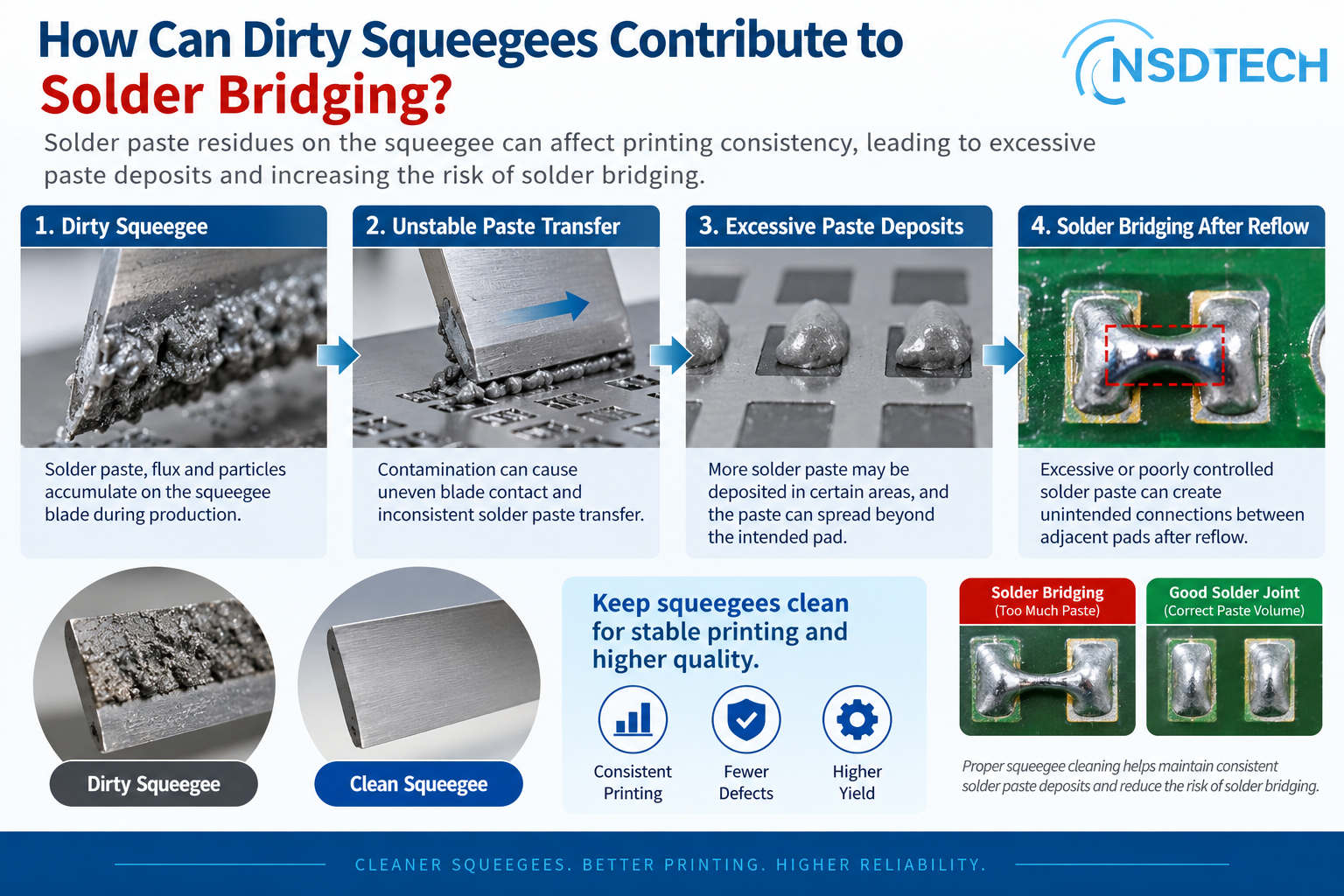
How Can Dirty Squeegees Contribute to Solder Bridging?
Solder bridging occurs when solder creates an unintended electrical connection between adjacent pads or component leads.
Fine-pitch PCB assemblies are particularly sensitive because the spacing between neighboring solder deposits is very small.
A contaminated or poorly maintained squeegee can contribute to unstable paste distribution during printing.
This may result in:
- Excess solder paste in certain areas
- Paste spreading beyond the intended pad
- Irregular deposit edges
- Inconsistent separation between adjacent deposits
After component placement and reflow, excessive or poorly controlled solder paste can increase the possibility of bridging between neighboring solder joints.
Regular squeegee cleaning helps maintain a cleaner blade surface and more consistent printing conditions.
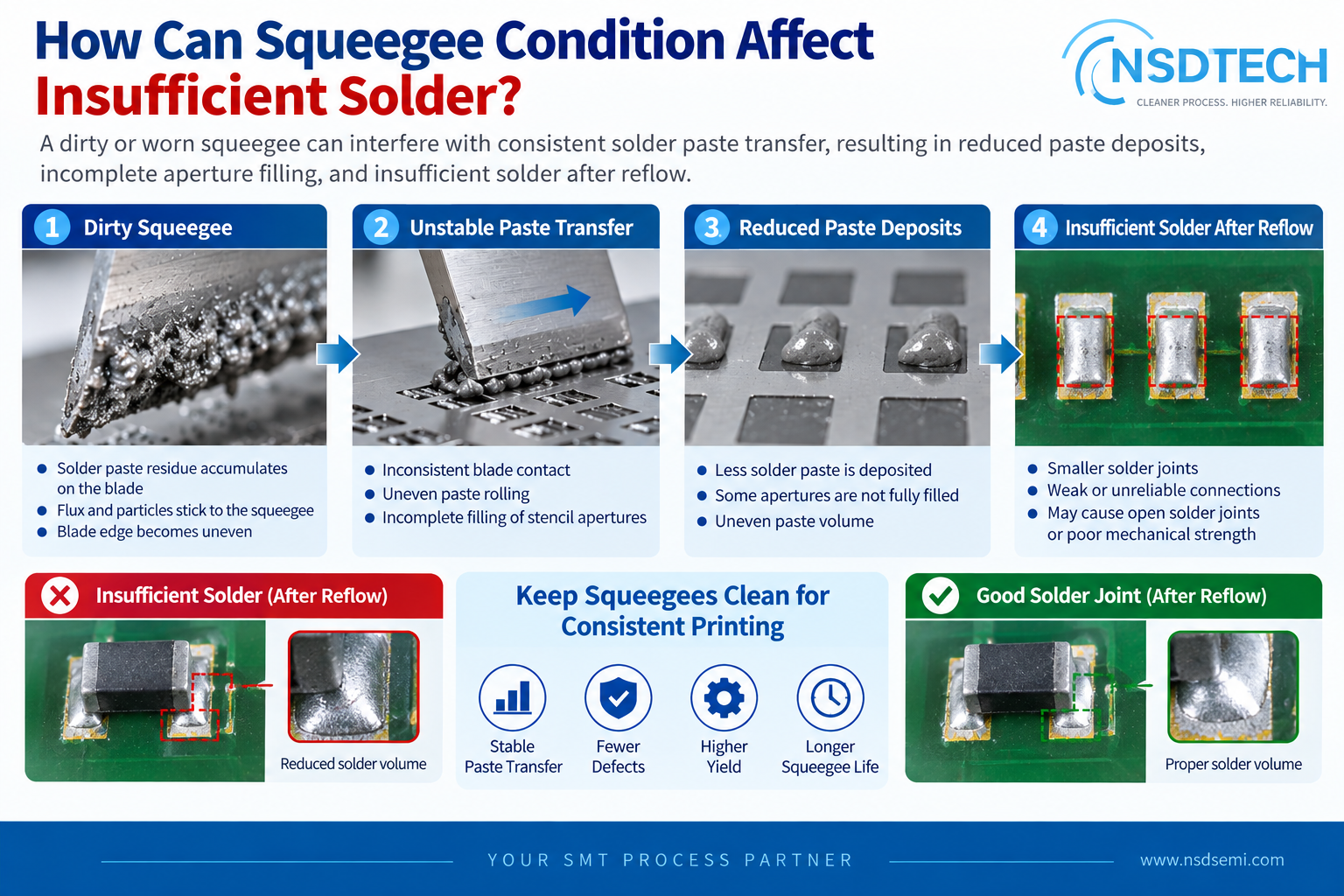
How Can Squeegee Condition Affect Insufficient Solder?
Insufficient solder occurs when the solder paste deposited on a PCB pad is below the amount required to form a reliable solder joint.
Several printing-related factors can contribute to insufficient paste deposition.
If dried solder paste or other contamination remains on the squeegee, it may interfere with consistent paste movement across the stencil and affect aperture filling.
Potential results include:
- Reduced solder paste deposits
- Incomplete aperture filling
- Uneven paste volume
- Missing or weak deposits
- Greater printing variation between PCBs
After reflow, insufficient solder may contribute to weak or unreliable solder joints.
Keeping squeegees clean helps support more consistent solder paste transfer during production.
The Relationship Between Squeegee Cleaning and Printing Quality
The relationship can be understood as a simple process:
Contaminated Squeegee↓Unstable Blade Contact / Paste Transfer↓Inconsistent Solder Paste Printing↓Excessive or Insufficient Paste Deposits↓Higher Risk of Bridging or Insufficient Solder
Cleaning the squeegee removes accumulated contamination and helps restore a clean working surface.
This supports more stable stencil printing and reduces one source of process variation.
Why Is Manual Squeegee Cleaning Not Always Enough?
Manual cleaning can be suitable for some production environments, but cleaning quality may depend heavily on the operator.
Common challenges include:
- Inconsistent cleaning time
- Different cleaning methods between operators
- Residue remaining on blade edges
- Difficult-to-clean dried solder paste
- Excessive manual contact with the blade
- Variable drying conditions
For high-volume SMT production, these variations can make standardized process control more difficult.
Automated cleaning provides a more repeatable cleaning process.
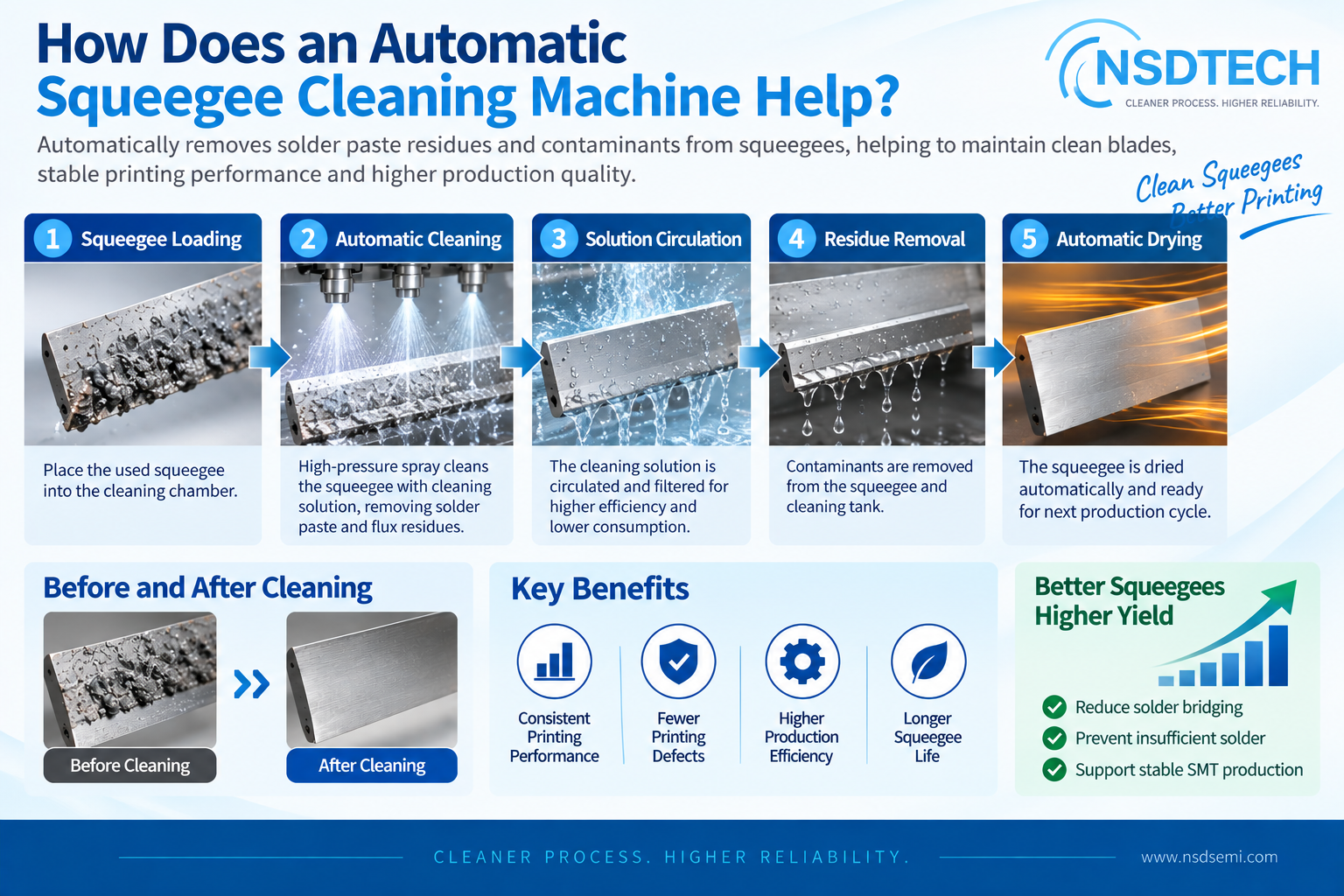
How Does an Automatic Squeegee Cleaning Machine Help?
An automatic SMT squeegee cleaning machine is designed to remove solder paste and process residues from the squeegee using a controlled cleaning cycle.
Depending on machine configuration, the process may include:
1. Squeegee Loading
The used squeegee is placed securely inside the cleaning chamber.
2. Automatic Cleaning
Controlled cleaning removes solder paste residues from the blade and other contaminated surfaces.
3. Cleaning Solution Circulation
The cleaning medium can be circulated during the cleaning process to improve cleaning efficiency and reduce unnecessary consumption.
4. Residue Removal
Contamination separated from the squeegee is removed from the cleaning area.
5. Automatic Drying
After cleaning, the squeegee is dried before being returned to production.
This creates a more standardized process:
Load → Clean → Remove Residue → Dry → Reuse
Benefits of Automatic Squeegee Cleaning
Introducing standardized squeegee cleaning into SMT production can help manufacturers:
- Maintain cleaner squeegee blades
- Improve printing process consistency
- Reduce solder paste residue accumulation
- Support stable solder paste transfer
- Reduce operator-dependent cleaning variation
- Improve repeatability between production batches
- Reduce the risk of printing-related defects
- Support preventive maintenance of SMT printing tools
For manufacturers producing fine-pitch, high-density, automotive, industrial, server, and other reliability-sensitive PCB assemblies, stable solder paste printing is especially important.
Email:nancy@nsdcorp.cnSqueegee Cleaning Should Be Part of SMT Process Control
Squeegee cleaning alone cannot eliminate every solder bridging or insufficient solder defect.
Printing quality also depends on factors such as:
- Stencil design
- Stencil cleanliness
- Solder paste condition
- Printing pressure
- Printing speed
- Separation parameters
- PCB support
- Stencil aperture condition
However, squeegee cleanliness is an important controllable factor.
Combining regular squeegee cleaning with stencil maintenance, optimized printing parameters, and SPI inspection can provide more comprehensive control over the solder paste printing process.
NSDTECH Squeegee Cleaning Solution
NSDTECH provides Squeegee Cleaning Machines for SMT production, designed to automate the cleaning process and help manufacturers maintain clean squeegees between production cycles.
By reducing solder paste and flux residues on squeegee surfaces, automated cleaning helps manufacturers establish a more repeatable maintenance process and supports stable solder paste printing.
For SMT factories seeking to reduce printing variation and improve process consistency, automatic squeegee cleaning can become an important part of the overall printing quality-control strategy.
Conclusion
Solder bridging and insufficient solder can originate from multiple stages of the SMT printing process. A contaminated squeegee is one factor that can contribute to inconsistent solder paste deposition.
Regular and controlled squeegee cleaning helps maintain a clean blade surface, supports consistent solder paste transfer, and reduces process variation.
For modern SMT manufacturing, particularly fine-pitch and high-density PCB assembly, automated squeegee cleaning provides a practical way to strengthen printing process control and support more consistent production quality.
About Us
As a global intelligent equipment &material provider, NSDTECH has continued to focus on SIX major fields: Semiconductor Packaging and Testing Equipment; Semiconductor Packaging and Testing Materials; AI+Vision Inspection; Automated Testing; Intelligent Manufacturing; PCBA Auxiliary Materials since 2011 for global customers. We provide customers with cost-effective to their total solutions requirement.
Media Contact
Company Name: Shenzhen Nsdtech Technology Co., Ltd.
Contact Person: Media Relations
Email: Send Email
Country: China
Website: https://www.nsdsemi.com/


