
Jordan Ellis’s ASVAB guide connects vocabulary study to applicant goals
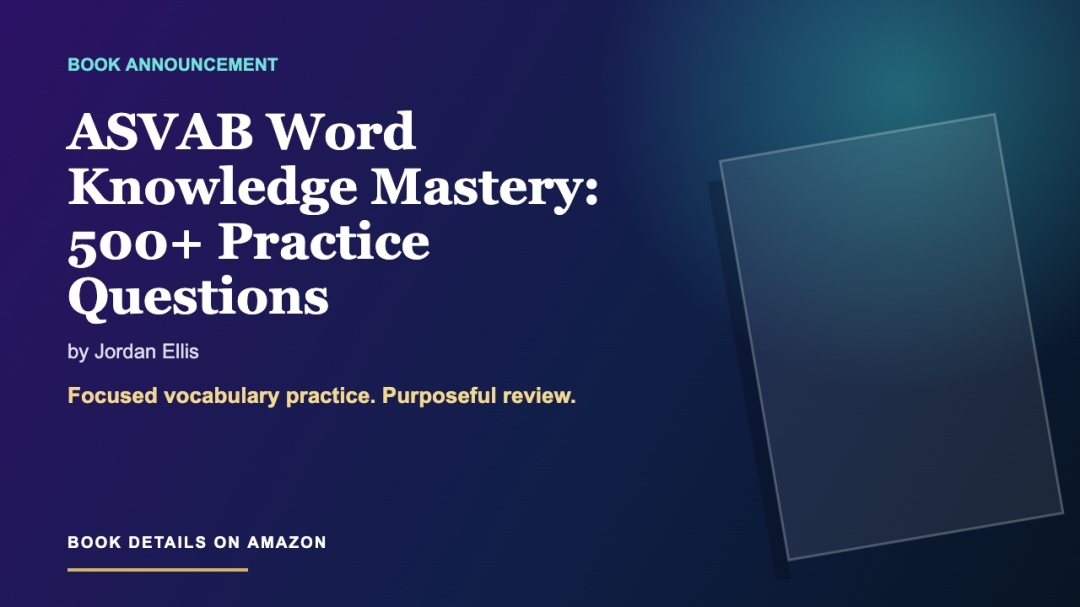
HOUSTON, TX – October 21, 2026 – Jordan Ellis’s ASVAB Word Knowledge Mastery: 500+ Practice Questions, published October 19, 2026, brings a reader-focused approach to vocabulary preparation for Air Force applicants. The book combines ASVAB synonym practice questions with methods for approaching unfamiliar terms, interpreting context, and reviewing errors. Its central concern is the relationship between practice and purpose: helping applicants connect individual vocabulary exercises to their broader preparation goals rather than treating study as an endless sequence of words to memorize.
For its intended readers, the challenge described in the book is not simply encountering an unknown word. It is encountering that word alongside near synonyms and misleading answer choices under time pressure. Those conditions give vocabulary preparation a practical dimension. A learner needs to consider which meaning fits best, what information is useful, and how to proceed when recognition is incomplete. The guide addresses those concerns through a combination of original questions, foundational techniques, and a review framework.
The title’s “500+” description refers to a collection of 540 original practice questions. The title and the stated total therefore describe the same resource at different levels of precision: 540 is the specific count within the broader 500-plus description. Those questions sit within a ten-chapter structure that progresses from foundational techniques toward realistic rehearsal. The emphasis is not on question quantity in isolation, but on giving readers material through which to apply methods and revisit areas that require attention.
Connecting vocabulary preparation to an Air Force goal
The book begins its approach with establishing a baseline and connecting practice to an Air Force goal. That connection matters to the audience because it gives vocabulary work a defined purpose. Instead of presenting memorization as an end in itself, the guide frames preparation around understanding a starting point and directing subsequent study. Its focus remains Word Knowledge, allowing readers to approach that area through a coherent sequence rather than an unrelated collection of vocabulary tasks.
A useful vocabulary core is another part of that approach. The book contrasts this with reliance on endless word lists, placing attention on knowledge that readers can practice applying. For applicants, the distinction is between collecting terms and working with meaning. Recognizing a word, distinguishing it from a similar one, and considering its relationship to an answer choice are connected activities, but they are not interchangeable. The guide brings those activities together within its preparation framework.
Why close meanings deserve attention
Synonym practice is especially relevant to the book’s concern with identifying the closest meaning. Similar words can create uncertainty precisely because more than one option may appear plausible. The guide includes work on near synonyms and commonly confused words, making those distinctions an explicit part of preparation. For the reader, this shifts attention from a vague sense that two words are related toward a more careful consideration of how their meanings differ.
Within that context, ASVAB synonym practice questions serve as opportunities to examine choices, not just select an answer and move on. The book’s stated approach asks readers to look at errors and recognize patterns across their work. A missed distinction can therefore become a focus for further study. This is a reader-relevant theme because it connects an immediate difficulty in a practice question with a concrete direction for the next round of preparation.
Working with incomplete knowledge
The guide also addresses what happens when a reader does not know a word. Its methods include using prefixes and roots wisely, considering sentence clues, and applying practical strategies to unfamiliar vocabulary. Importantly, its treatment of word parts includes a caution against overusing them or guessing blindly. The purpose is not to present one technique as a universal solution, but to give readers several ways to approach uncertainty while recognizing the limits of individual clues.
Context and word parts have complementary roles in this framework. Sentence clues can help narrow possible meanings, while prefixes and roots provide another basis for examining a term. The book also maintains a separate focus on distinguishing similar words. Together, these themes address different sources of hesitation: lack of familiarity, uncertainty about context, and difficulty separating close alternatives. Their relevance lies in meeting readers at the points where vocabulary practice can become less straightforward than simple recall.
Making mistakes useful for the next session
How can ASVAB learners review vocabulary mistakes? The book’s framework is to examine errors, identify patterns, and direct study toward the areas needing the most attention. It pairs that process with a mistake-driven review plan intended to strengthen retention. Rather than making completion the sole measure of a study session, this approach gives readers a reason to return to difficult material and consider what their answers reveal about their preparation needs.
The progression from focused drills to mixed and timed practice extends that review process. Focused work allows attention to particular techniques, while mixed and timed work forms part of the movement toward realistic rehearsal. For Air Force applicants seeking structure, the value of this arrangement is its continuity: establishing a baseline, practicing methods, examining mistakes, and moving into broader practice belong to the same study approach. The guide presents these activities as connected parts of vocabulary preparation rather than separate tasks.
ASVAB Word Knowledge Mastery: 500+ Practice Questions is written around the needs of Air Force applicants who want a structured vocabulary resource. Its themes emphasize purposeful practice, careful attention to meaning, and learning from errors without treating unfamiliar vocabulary as a reason for blind guessing. Readers can explore Jordan Ellis’s book and its 540-question preparation framework on Amazon: https://www.amazon.com/dp/B0GZJLQ9K6
About Jordan Ellis
Jordan Ellis is the author of ASVAB Word Knowledge Mastery: 500+ Practice Questions, a vocabulary preparation guide for Air Force applicants. The book combines 540 original practice questions with a ten-chapter framework covering word meaning, prefixes and roots, context clues, near synonyms, unfamiliar vocabulary, and mistake-driven review.
Video Link: https://www.youtube.com/embed/sPaDKaSj6bI
Media Contact
Company Name: ASVAB Word Knowledge Mastery
Contact Person: Jordan Ellis
Email: Send Email
Phone: 713-392-6222
Address:450 N Sam Houston Prky E Ste 193
City: Houston
State: TX
Country: United States
Website: https://u8ogx0bnrokwr85ce63gsox9.macaly.app


