
Day Trading Kills Examines the Real Costs of Retail Day Trading and Challenges the Online Trading Narrative
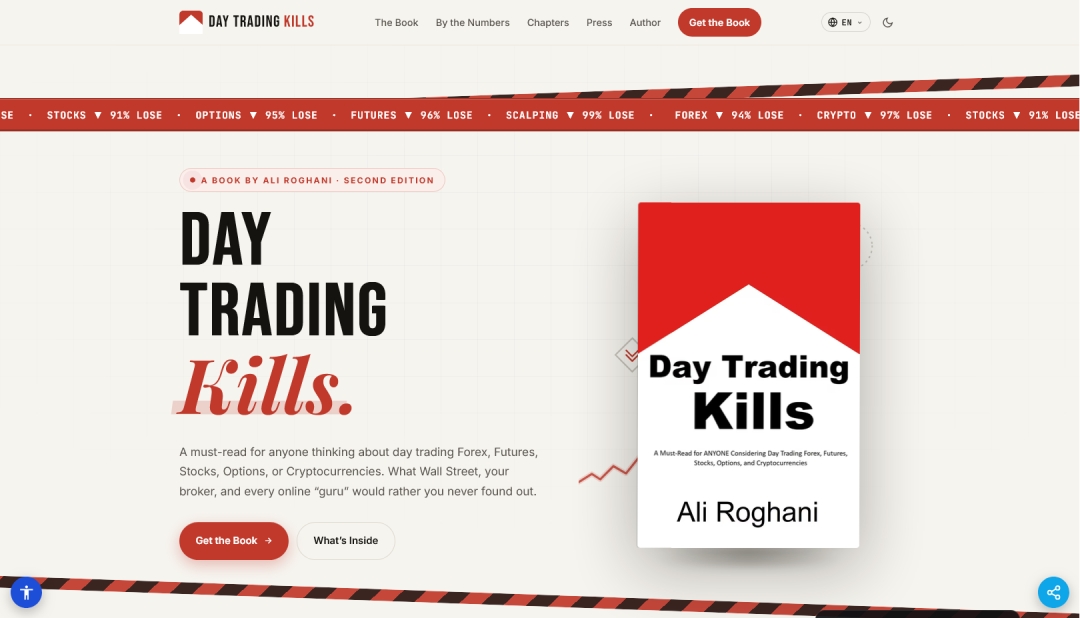
London, United Kingdom – September 21, 2026 – As social media continues to expose millions of people to images of rapid profits, trading screens, luxury lifestyles, and promises of financial independence, Day Trading Kills offers a different perspective: an examination of what the available evidence says about the long-term experience of retail day traders.
Written by Ali Roghani, Day Trading Kills examines day trading across Forex, futures, stocks, options, and cryptocurrencies, combining financial analysis with discussions of trading costs, leverage, psychology, market structure, risk management, and potential alternatives to short-term speculation. The book was originally published in 2022, with a second edition following in 2023 containing updated research and analysis.
Looking Beyond the Highlight Reel
The modern trading environment has made it easier than ever for individuals to access financial markets.
Opening a brokerage account can take minutes, while social media platforms provide a continuous stream of trading content, screenshots of profitable positions, technical-analysis videos, trading signals, courses, and stories of exceptional returns.
What is often more difficult to find is a comprehensive examination of the outcomes experienced by the broader population of retail traders.
That question forms the foundation of Day Trading Kills.
Rather than presenting day trading as a guaranteed path to wealth—or attempting to teach readers a particular trading strategy—the book examines the evidence surrounding retail trading outcomes and the structural factors that can influence them.
The book’s accompanying Day Trading Knowledge Base organizes key concepts into a structured reference covering subjects including day-trading statistics, trading costs, leverage, CFDs, broker economics, prop-firm challenges, and the distinction between trading and long-term investing.

What Does the Evidence Say?
One of the central themes of Day Trading Kills is the difference between individual success stories and aggregate outcomes.
Research cited by the project includes studies involving retail traders in Brazil and Taiwan, alongside regulatory disclosures and other market data.
For example, the website’s discussion of day-trading profitability cites research showing that 97% of persistent day traders in a Brazilian futures market study lost money, while only a small minority achieved results exceeding basic income benchmarks. Other research and regulatory disclosures similarly show substantial rates of retail losses across leveraged products and markets.
These figures do not mean that every individual trader will lose money. Instead, they describe observed outcomes across particular populations and periods, highlighting the substantial difficulty retail participants face when attempting to generate consistent net returns through frequent trading.
The Difference Between Gross and Net Results
A major issue examined by the book is the distinction between a profitable trade and a profitable trading activity.
Every transaction can involve costs such as spreads, commissions, slippage, financing charges, and, depending on the jurisdiction and circumstances, taxation.
A strategy can therefore appear successful before costs while producing a substantially different result after all expenses are included.
The Trading Statistics section of the website presents data and visualizations intended to illustrate the difference between headline trading results and longer-term retail outcomes.
This distinction is particularly relevant for beginners because a small number of successful trades can create an impression of skill even when the longer-term results do not demonstrate a sustainable advantage.
Five Major Markets, Different Risks
Day Trading Kills examines five major areas of retail trading: Forex, futures, stocks, options, and cryptocurrencies.
Each market has its own characteristics and risks.
Forex and CFDs can involve leverage and financing costs. Futures provide leverage and require an understanding of contract specifications, margin, and settlement. Options introduce time decay and other complexities. Cryptocurrency markets can experience substantial volatility, while stock trading involves its own combination of market risk, transaction costs, and competition.
Although these markets differ considerably, the book examines recurring themes across them, including transaction costs, leverage, behavioural biases, risk management, market competition, and the difficulty of maintaining a consistent edge.
Leverage Can Magnify Outcomes
Leverage is another major subject examined throughout the book.
Borrowing or using leveraged financial products can increase the size of a position relative to the trader’s available capital. This can amplify gains, but it can also magnify losses.
For retail traders, understanding leverage therefore requires more than knowing the headline potential return. It requires understanding margin requirements, financing costs, liquidation mechanisms, volatility, and the possibility that relatively small market movements can produce disproportionately large changes in account value.
The book examines leverage alongside other structural features of retail trading and considers how these factors can affect outcomes over time.
The Psychology of Short-Term Trading
Financial markets are not purely mathematical environments.
People make decisions under uncertainty, and frequent trading can create repeated opportunities for emotions and behavioural biases to influence those decisions.
Day Trading Kills examines subjects including fear, greed, overconfidence, loss aversion, revenge trading, discipline, and the psychological pressures associated with repeated gains and losses.
Its Chapters cover these subjects alongside market mechanics, leverage, trading costs, manipulation, health considerations, addiction, relationships, gambling, scams, trading signals, automated trading, and alternative approaches.
The book does not treat these challenges as simply matters of individual willpower. Instead, it examines how the structure and frequency of short-term trading can repeatedly expose participants to emotionally difficult decisions.
When Trading Becomes More Than a Financial Activity
For some people, trading can become increasingly time-consuming.
Constantly watching prices, monitoring positions, searching for market-moving information, and responding to short-term price movements can turn trading into a substantial part of everyday life.
The book examines topics including isolation, disrupted routines, relationships, stress, and problematic trading behaviour as part of its broader discussion of the personal consequences associated with intensive day trading.
These subjects are included because the cost of trading cannot always be measured solely by the balance of a brokerage account.
Time, attention, stress, and relationships can also become part of the equation.
The Role of Online Trading Influencers
Another major subject explored in Day Trading Kills is the modern trading-influencer ecosystem.
Online audiences encounter traders presenting profitable screenshots, expensive cars, travel, large homes, and apparently rapid financial success. Some creators also sell courses, subscriptions, signals, communities, software, or other trading-related products.
The existence of successful traders or profitable educational businesses does not by itself demonstrate that retail day trading is broadly profitable.
The book therefore examines the incentives surrounding trading content and encourages readers to distinguish between marketing claims, individual anecdotes, and evidence derived from larger datasets.
Prop-Firm Challenges and Trading Services
The modern retail trading ecosystem has also expanded beyond conventional brokerage accounts.
Paid trading challenges, signal services, automated systems, courses, communities, and other products can create additional costs for people attempting to become active traders.
Day Trading Kills examines these services and asks an important question: what evidence demonstrates that paying for a particular service improves a retail trader’s long-term probability of success?
The book’s knowledge base specifically addresses prop-firm challenges, trading costs, broker economics, and related topics.
Trading Versus Long-Term Investing
The book also distinguishes between short-term trading and long-term investing.
These activities have fundamentally different objectives and time horizons.
Day trading attempts to capitalize on short-term price movements, often involving frequent transactions. Long-term investing generally involves holding diversified assets over extended periods and relying on broader economic growth and compounding rather than attempting to repeatedly predict short-term market movements.
The book discusses index investing, diversification, dollar-cost averaging, and other approaches as alternatives that readers can investigate when considering how to approach long-term wealth building.
The purpose is not to suggest that every investment approach is suitable for every individual, but to encourage readers to compare different strategies based on evidence, costs, time commitment, risk, and objectives.
A Research-Based Approach to a Highly Marketed Subject
The central premise of Day Trading Kills is straightforward: before risking significant capital, prospective traders should understand the actual evidence surrounding the activity.
The book brings together academic studies, regulatory information, market data, and analysis of the mechanics of retail trading.
The website’s Evidence & Research resources provide readers with additional information about the statistics and research discussed throughout the project.
This approach is particularly relevant in an environment where financial content can spread rapidly online and where exceptional outcomes can receive considerably more attention than typical ones.
A Book for People Considering Day Trading
Day Trading Kills is aimed particularly at people considering entering the retail trading world, as well as existing traders who want to examine the activity from a broader perspective.
The book covers 28 chapters, beginning with day-trading methods and markets and moving through technical and fundamental analysis, emotions, leverage, costs, health, relationships, addiction, gambling, scams, trading services, automated trading, financial stability, alternatives, and a final assessment.
Its underlying objective is to encourage readers to investigate the evidence before committing substantial money, time, or attention to an activity that can carry significant financial risk.
About Day Trading Kills
Day Trading Kills is a book by Ali Roghani examining retail day trading across Forex, futures, stocks, options, and cryptocurrencies.
The book combines financial research, market analysis, regulatory information, and discussion of the psychological and personal dimensions of intensive short-term trading.
The first edition was published in 2022, followed by a second edition in 2023. The book is available in hardcover, paperback, eBook, and audiobook formats through multiple retailers.
Readers can learn more about the book and its research at https://DayTradingKills.com
Media Contact
Company Name: Day Trading Kills
Contact Person: Media Team
Email: Send Email
Address:27 Old Gloucester Street
City: London
State: England
Country: United Kingdom
Website: https://daytradingkills.com/


