
China Makes 75% of the World’s Batteries, and AI Data Centers Just Became Its Newest Customer.
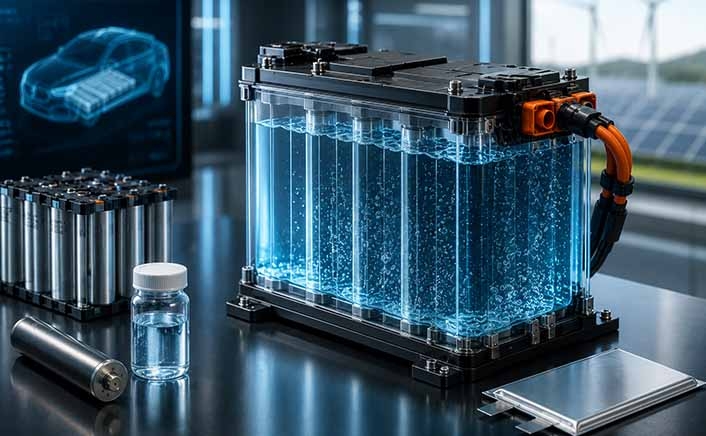
Electric vehicles built this industry. Grid storage and AI data centers are now expanding it into something considerably larger. The Global Liquid Lithium-Ion Battery Market, valued at USD 68.70 billion in 2025, is projected to reach USD 233.40 billion by 2033, more than tripling at a CAGR of 16.5% with volume climbing from 1,790 GWh to 5,670 GWh over the same period.
A Technology That’s Already Won, Still Growing Fast
Liquid lithium-ion batteries are not just an emerging technology vying for market share; they already constitute over 95% of all commercial lithium-ion battery deployments in electric vehicles (EVs), consumer electronics, and stationary storage. The scale is truly remarkable: according to the International Energy Agency, global EV sales topped 17 million units in 2024, and annual battery demand exceeded 1 TWh for the first time. China alone accounts for nearly 60% of worldwide EV battery demand, significantly influencing the industry’s supply chain and pricing dynamics.
Access the Full Report Here: https://marksparksolutions.com/reports/global-liquid-lithium-ion-battery-market
Why Grid Storage Is the Segment to Watch
Electric vehicles continue to be the dominant segment by a large margin. However, Energy Storage Systems are expanding more rapidly than any other sector, and understanding the reasons behind this growth is crucial for those observing the industry over the next decade. In 2024, global energy storage deployments surpassed 70 GW (150 GWh), driven by the global push for renewable energy integration and grid upgrades, as reported by BloombergNEF. Projects combining solar and storage, virtual power plants, and initiatives to enhance grid flexibility are all drawing on the same battery supply chain that previously primarily supported electric vehicles.
Adding to that is a new significant demand driver: AI infrastructure. Hyperscale data centers, which handle AI tasks, require large backup power supplies. This need is increasingly fulfilled by lithium-ion batteries similar to those used in electric vehicles and grid storage, creating a convergence that broadens this market’s potential far beyond its initial focus on automotive applications.
Download Free Sample Report Here:https://marksparksolutions.com/sample-reports?1054&Download_Free_Sample
Where the Batteries Actually Get Made
China’s control over manufacturing is nearly complete. The country produces over 75% of the world’s lithium-ion battery cells and dominates more than 90% of anode and electrolyte capacity, as reported by the IEA. Leading the market, CATL and BYD hold approximately 38% and 17% shares respectively, based on SNE Research data, meaning just two Chinese firms supply the majority of the world’s EV batteries.
Manufacturing is gradually diversifying geographically, though at a slower pace than China’s rapid growth. South Korea’s LG Energy Solution, Samsung SDI, and SK On are continuing to enhance advanced battery production capabilities. At the same time, Panasonic Energy remains a major supplier of cylindrical batteries for premium electric vehicle (EV) manufacturers. North America has also seen substantial investments, with the U.S. Department of Energy reports indicating that investments in battery manufacturing here exceeded USD 100 billion from 2021 to 2024. This reflects a strong movement towards localizing the supply chain, supported by policies such as the Inflation Reduction Act’s production tax credits.
Over 400 battery giga factories have been announced worldwide, as per Benchmark Mineral Intelligence. Bloomberg NEF predicts that by 2030, the installed manufacturing capacity will surpass 8 TWh, more than twice the 3.1 TWh projected for 2024, assuming these projects go ahead as scheduled.
The Chemistry Race Behind the Scenes
Lithium Iron Phosphate (LFP) has emerged as the leading chemistry for mass-market electric vehicles (EVs), accounting for over 40% of global EV battery demand in 2024. It is valued for its lower cost and better thermal stability compared to nickel-based options. A notable example of its enhanced performance is CATL’s Shenxing fast-charging LFP battery, which can provide about 400 km of range in just 10 minutes, demonstrating significant progress beyond its initial reputation as an affordable chemistry. Meanwhile, high-nickel NMC and NCA chemistries are still favored for premium EVs where higher energy density is prioritized over cost. Manufacturers are also advancing efforts to reduce reliance on critical raw materials by pushing silicon-rich anodes and cobalt-reduced cathodes to achieve faster charging and lessen geopolitical dependencies.
What Could Slow This Down
The industry’s growth path faces real risks. Fluctuations in raw material prices, such as lithium prices dropping sharply after their record highs in 2022, pose ongoing concerns. Nickel and cobalt markets remain vulnerable to geopolitical disruptions due to their concentrated supply chains. Additionally, high capital requirements—modern battery gigafactories often need between USD 2 billion and USD 5 billion—make profitability heavily reliant on reaching large-scale production and high utilization, which presents a significant hurdle for smaller or newer players.
Government Policy Is Actively Reshaping Where Batteries Get Built
Policy support has evolved into a key competitive advantage rather than just a background factor. Initiatives like the EU Battery Regulation, the European Battery Alliance, and India’s 50 GWh Advanced Chemistry Cell PLI program are actively working to develop regional battery value chains and decrease reliance on imports. These efforts are expected to gradually shift manufacturing focus, even though China still maintains its current leadership.
Who’s Competing for This Growth
CATL and BYD lead the competitive landscape, with LG Energy Solution, Panasonic Energy, Samsung SDI, and SK On following in premium automotive markets. Other key players include CALB Group, Gotion High-Tech, EVE Energy, SVOLT Energy Technology, Farasis Energy, AESC Group, Toshiba, and Sunwoda Electronic, forming a truly global manufacturing network. These companies compete through advances in chemistry, manufacturing capacity, and, increasingly, recycling capabilities as stricter circular economy standards develop.
Where This Market Heads Next
As gigafactory capacities grow worldwide and lithium-ion batteries find new uses in grid storage and AI infrastructure backup, this market’s expansion appears poised to go beyond the automotive sector, assuming raw material supply chains and recycling infrastructure can scale quickly enough to support this growth.
Battery manufacturers, automotive OEMs, and energy storage developers assessing this market can utilize Mark & Spark Solutions’ comprehensive market study to access detailed chemistry, application, and competitive segmentation.
Organizations interested in gigafactory investments, chemical innovations, or regional supply chain strategies can request a customized data excerpt tailored to their strategic goals.
Media Contact
Company Name: Mark & Spark Solutions
Contact Person: Sushil
Email: Send Email
Phone: 9158340999
Address:2nd Floor, Panchsheel Park, Aundh
City: Pune
State: Maharashtra
Country: India
Website: https://marksparksolutions.com/reports/global-liquid-lithium-ion-battery-market


